







Gjør som tusenvis av andre bokelskere
Abonner på vårt nyhetsbrev og få rabatter og inspirasjon til din neste leseopplevelse.
Ved å abonnere godtar du vår personvernerklæring.Du kan når som helst melde deg av våre nyhetsbrev.

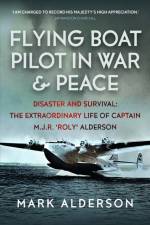
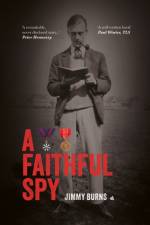
At the age of twelve, on hearing that Sir Ross Smith had broken the England-Australia aero record in a Vickers Vimy, Roly Alderson decided that he wanted to fly. Denied a secondary education, orphan Roly was an accomplished engineer by the time he arrived at Cambridge in his home-built car. He left with a degree, a racing Bentley and a pilot's licence. Alderson had already logged several hundred hours when recruited by Imperial Airways in 1933. His skills were quickly recognized, and he was selected to fly Lord Willingdon, the Viceroy and Governor General of India, on his farewell tour of India. Alderson's Holy Grail, nevertheless, was to 'fly boats', and it was not long before Roly had joined these venerated ranks on the new route to South Africa. Whilst serving as a Captain on Imperial Airways' prestigious New York-Bermuda service, Alderson reported a number of serious concerns regarding carburettor icing on his Short Empire flying boat Cavalier. His prescience was ignored, and on 21 January 1939, a day after penning a final warning, Cavalier was forced down into the empty wastes of the Atlantic. Due to Alderson's consummate airmanship and the bravery of heroine passenger Edna Watson, ten of the thirteen souls on board survived. Their miraculous rescue by the tanker Esso Baytown, part of a huge international search and rescue effort, after eleven gruelling hours in cold shark-infested waters, dominated the world's headlines. Alderson returned to duty on the long-distance flying boat routes to Singapore and Durban, but, following the German invasion of France in 1940, he was transferred to the treacherous West Africa run. After a brush with a U-boat off Sierra Leone, he was tasked with ferrying General de Gaulle back to the UK from Nigeria. After avoiding a suspected poisoning attempt at Freetown and Luftwaffe interception over the Bay of Biscay, the General personally thanked Alderson for his safe return. Later, in 1940 the British Government bought three huge Boeing flying boats to maintain the wartime transatlantic link, and Alderson was promoted to the roster for these. The hours in these behemoths were prodigious, routing via Portugal, West Africa, and Brazil, with the fear of enemy attack a constant and very real threat. Only V.I.P.s and vital mail were carried, although Alderson did once deliver President Roosevelt's personal gift to Winston Churchill: a critical supply of Havana cigars!Adventure abounds in this remarkable story of a flying boat pilot and captain in both war and peace: racing Bentleys, landing on beaches, black-tie dinner with the Luftwaffe, landing on the Nile, flying across India, and espionage and intrigue in Lisbon.
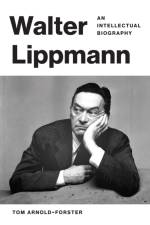
The life and ideas of one of the twentieth century's leading political thinkersWalter Lippmann (1889-1974) was among the most influential and wide-ranging political writers in modern America. As both a journalist and political theorist, he shaped ideas about liberalism and democracy, the nature of public opinion, US power and empire, and the roles of journalists, experts, and citizens. Tom Arnold-Forster provides a bold historical reassessment of Lippmann's intellectual life, offering fresh perspectives on a career at the intersection of daily news and democratic theory. This incisive book shows how Lippmann helped define the public debates of American liberalism from the Progressive Era to the Cold War. By exploring his ideas in their historical context, Arnold-Forster challenges the claim that Lippmann was primarily a theorist of expertise and technocracy. Instead, Lippmann emerges as a strikingly political thinker, public-facing and multifarious, who focused on what politics meant and how it worked in modern democracies. Covering subjects from press freedom to urban reform to economic and foreign policy, while tracing the evolution from his early liberal socialism to later conservative liberalism, this book explores Lippmann's thought as reflecting the protean character of liberal politics and the crises and paradoxes of democracy. Walter Lippmann: An Intellectual Biography is a richly historical account of a complex political thinker. Lippmann's ideas played a formative role in the twentieth century and resonate powerfully with our fraught present.
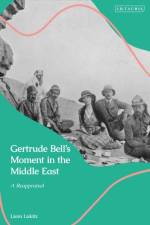
A re-evaluation of the life and legacy of Gertude Bell in the Middle East.
Tap Code is the untold story of ex-Vietnam POW Colonel Carlyle "Smitty" Harris, who brought hope, strength, and the love of God to fellow American POWs by secretly reviving a long-unused military communication code. It was a lifeline as they endured torture and abuse, bringing unity and ultimately helping them prevail over a brutal enemy.
The war treasures of Bose were confiscated by the Allied troops in Saigon during a search operation.
Lady Anne Bacon was a highly educated woman who lived through the political and religious transitions of five reigns, embedded at the Tudor court. Drawing on her forthright letters and other sources, this deeply researched and compellingly readable book reveals her extraordinary part in shaping the public story of Tudor history.
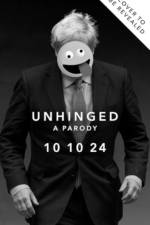
Be more Boris thanks to this parody collection of invaluable life lessons that will guarantee you success no matter what situation you might find yourself in
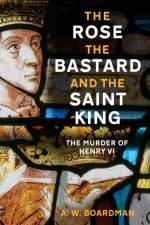
The story of one king at war, another who could not be allowed to live and the bastard who sparked rebellion and a siege of London that changed the course of British history.
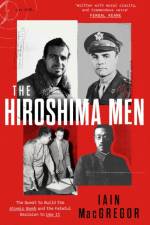
At 8:15 a.m. on August 6th, 1945, the Japanese port city of Hiroshima was struck by the world's first atomic bomb. Built in the US by the top-secret Manhattan Project and delivered by a B-29 Superfortress, a revolutionary long-range bomber, the weapon destroyed large swaths of the city, instantly killing tens of thousands. The world would never be the same again.The Hiroshima Men's unique narrative recounts the decade-long journey towards this first atomic attack. It charts the race for nuclear technology before, and during the Second World War, as the allies fought the axis powers in Europe, North Africa, China, and across the vastness of the Pacific, and is seen through the experiences of several key characters: General Leslie Groves, leader of the Manhattan Project alongside Robert Oppenheimer; pioneering Army Air Force bomber pilot Colonel Paul Tibbetts II; the mayor of Hiroshima, Senkichi Awaya, who would die alongside over eighty-thousand of his fellow citizens; and Pulitzer Prize-winning novelist John Hersey, who travelled to post-war Japan to expose the devastation the bomb had inflicted upon the city, and in a historic New Yorker article, described in unflinching detail the dangers posed by its deadly after-effect, radiation poisoning.This thrilling account takes the reader from the corridors of the White House to the laboratories and test sites of New Mexico; from the air war above Nazi Germany and the savage reconquest of the Pacific to the deadly firebombing air raids across the Japanese Home Islands. The Hiroshima Men also includes Japanese perspectives - a vital aspect often missing from Western narratives - to complete MacGregor's nuanced, deeply human account of the bombing's meaning and aftermath.
¿We¿ve railed against injustice for decade upon decade, a lifetime of struggle and progress and enlightenment that we see etched in Fredrick Douglass¿s mighty, leonine gaze.¿ -Barack Obama¿My Bondage and my Freedom, besides giving a fresh impulse to antislavery literature, shows upon its pages the untiring industry of the ripe scholar.¿-William Wells BrownMy Bondage and my Freedom (1845), a classic of American History writing and one of the most influential and ennobling autobiographies ever written, was composed while Fredrick Douglas was at his heights as an orator and writer. At the time of writing, Douglass had also reached the pinnacle of his work as a leader in the abolitionist movement and as an influential newspaper publisher. This incisive and eloquent book is at once an extraordinary story of resilience and a meditation on power, education, and freedom. The depictions of Fredrick Douglass¿s early life on a Maryland slave plantation, the series of relocations and abuses under various overseers, and his eventual freedom are an extraordinarily vivid portrait of the United States leading up to the beginning of the Civil War. My Bondage and my Freedom is a brilliant account of a singular life and as well as a scathing reproach to one of the darkest episodes of American history. With an eye-catching new cover, and professionally typeset manuscript, this edition of My Bondage and my Freedom is both modern and readable.
The Education of Henry Adams follows the life of presidential descendent Henry Adams. However, instead of serving just as an account of Adams' deeds, The Education of Henry Adams is a series of observations and introspections Adams makes on social changes, scientific advancements, personal relationships, professional success, travel, religion, war, and education. Born into the privilege of wealth and the renowned success of his ancestors, President John Adams and President John Quincy Adams, Adams received an education from notable schools, such as Harvard. He continued his prestigious education in Berlin, studying law and the German language. Despite his formal education, Adams felt unprepared to face the changing dynamics of his country, including shifts in social, religious, political, and scientific beliefs. For this reason, Adams advocates for "self-education" through experience, friendships, and reading. In his autobiography, Adams endorses studying American history and science in school, and encourages the process of self-educating after one's formal education. With a set of strong political and religious beliefs, Adams invokes a substantial impression with his perspectives on the on-going transformation of the United States of America. Henry Adams' autobiography, The Education of Henry Adams, has earned remarkable acclaim, including receiving a Pulitzer Prize. As a man who had direct access to many American political offices, including the presidential cabinet, the senate, and the congress, Adams had an intimate view of the innerworkings of American politics, and lived through social changes such as the Civil War, the abolition of slavery, scientific advancements, shifts in religious views, and the first World War. Though he felt his formal education left him unprepared for such happenings, Adams encourages readers to learn from their experiences and relationships. The Education of Henry Adams offers invaluable insight on the rapid changes in society, and reminds readers that one's education is never finished. Now with a new, eye-catching cover design and reprinted in a modern font, The Education of Henry Adams by Henry Adams is more accessible than ever and able to offer modern-day readers insight on historical events and philosophy of learning that will always be relevant.
Elizabeth Keckley reveals the hardships of slavery and the changing political climate in Washington amongst the country's most powerful couple, Abraham and Mary Lincoln. Keckley had unprecedented access, giving insight into their state during and after the Civil War. Elizabeth Keckley was born into slavery and experienced a traumatic upbringing riddled with physical and sexual violence. One attack resulted in the birth of her son, whom she named George. Elizabeth was a gifted seamstress who used her skills to save money to buy her and her son's freedom. She ventured North and started a career as a dressmaker to influential women in political circles. One of her most notable clients was Mary Todd Lincoln, with whom she developed a close friendship. Behind the Scenes is a harrowing story of one woman's unshakable drive. Despite her limiting circumstances, Elizabeth Keckley earned her freedom and became a successful entrepreneur. It's an inspiring tale that provides a personal account of one of the most volatile times in American history. With an eye-catching new cover, and professionally typeset manuscript, this edition of Behind the Scenes is both modern and readable.
From a child slave put to hard labor to a college president and advisor to presidents, Booker T. Washington¿s autobiography powerfully describes his journey and what it taught him about the possible future of Blacks in the United States.This autobiography is a cornerstone work of African-American literature. Washington tells of his experience in bondage as a child-slave, the hard labor he performed in salt mines post-slavery, and the role of his mother in demonstrating the strength and values that enabled him to continue to strive and rise above these often brutal circumstances. His hard-won education led him to become a teacher and build Tuskegee University with bare minimum resources, much of it literally one brick at a time. Despite these challenges, and encountering white opposition to the very concept of educating blacks, Washington believed that failing to make the university a reality would be a disservice to blacks nationwide. Inspiring throughout, the author advocates self-reliance through productive work, community service, and perseverance, and without bravado presents himself as a worthy example of how successful this path can be. His book still generates controversy as his conception of the rise of blacks through personal industry, leading gradually to their advancement in society, was deemed by some to be a slow and costly compromise. Others saw it as an example of pragmatic realism borne of necessity in the Reconstruction era South. Regardless of latter-day interpretations, Up From Slavery is a powerful document of how one man rose to prominence against terrible odds, then used his success and fame in a sustained attempt to better the lives of his fellows. This is an indispensable document of Black lives in an era scarcely more than 100 years in the past and its account of courage and dedication will not be forgotten.With an eye-catching new cover, and professionally typeset manuscript, this edition of Up From Slavery is both modern and readable.
My Own Story (1914) is a memoir by English political activist and suffragette Emmeline Pankhurst. Written at the onset of the First World War, My Own Story brings attention to Pankhurst¿s cause while defending her decision to cease activism until the end of the war. Notable for its descriptions of the British prison system, My Own Story is an invaluable document of a life dedicated to others, of a historical moment in which an oppressed group rose up to advocate for the simplest of demands: equality.Born in a politically active household, Emmeline Pankhurst was introduced to the women¿s suffrage movement at a young age. In 1903, she founded the Women¿s Social and Political Union (WSPU), an organization dedicated to the suffragette movement. As their speeches, rallies, and petitions failed to make headway, they turned to militant protest, and in 1908 Emmeline was arrested for attempting to enter Parliament to deliver a document to Prime Minister H.H. Asquith. Imprisoned for six weeks, she observed the horrifying conditions of prison life, including solitary confinement. This experience changed her outlook on the struggle for women¿s suffrage, and she increasingly saw imprisonment as a means of radical publicity. Over the next several years, she would be arrested seven times for rioting, destroying property, and assaulting police officers, and while in prison staged hunger strikes in order to gain the attention of the press and political establishment. My Own Story is a record of one woman¿s tireless advocacy for the sake of countless others.With a beautifully designed cover and professionally typeset manuscript, this edition of Emmeline Pankhurst¿s My Own Story is a classic of English literature reimagined for modern readers.
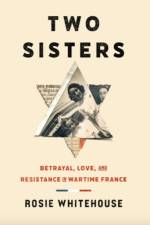
This riveting book is an astonishing testimony of what befell two sisters, Whitehouse's own mother-in-law and aunt, who managed to escape the killing fields in Vichy France against all odds.
"Gaza has always been rebellious... stubborn, addictive. I'm her daughter, and I look like her."
In My Early Life, Churchill describes his education and his experience in four wars on three continents as a young officer and newspaper correspondent, including his cavalry charge against the Dervishes at Omdurman in the Sudan and his capture and escape from a Boer prisoner of war camp in South Africa. He explains how he wrote his first five books and launched his political career before taking his seat in the House of Commons at twenty-six. By the time he wrote this book, the First World War had ushered in many changes, not all of them good, and Churchill perceived a low spirit in his countrymen. He thinks a time may come when young Britons will need more love of "adventure, and adventure for adventure's sake," which his early life exemplifies, and he offers "the new generation" his own "story of youthful endeavour" to encourage and rekindle the spirited part of their souls. Giving an account of his own life is a summons to young people who are drifting in an eddy of mass effects to surmount their fear of death, aiming to stir up unselfish endeavor in them. Lest anyone mistake his intention in writing the book, he dedicates it "TO A NEW GENERATION." This edition of My Early Life includes "The Dream." This short story was first mooted at a family meal at Churchill's country house at Chartwell in late November 1947, in the company of Winston and Clementine Churchill's children, Diana and Randolph. Diana asked her father, if he could conjure up anyone, who would fill an empty chair in the dining room. He replied that he would choose to dine with his own father, Lord Randolph Churchill, who had died more than fifty years earlier. He went on to describe a story he meant to write, based on a dream in which Lord Randolph returned to his son's painting studio to inquire what had occurred in the intervening half-century. Encouraged by his family's enthusiasm, Churchill wrote the story soon afterwards but, after revising it, set it aside to be published later. This "Private Article," as he styled it, first appeared a year after his death in the Sunday Telegraph, January 30, 1966, which described it as "his last story--locked away in a box for years--now published for the first time." By permission of Churchill College, it is reprinted, with explanatory editorial notes, as a fitting epilogue to Churchill's autobiography.
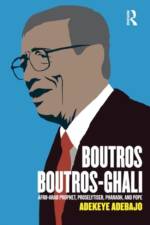
This is the first historical biography in English to be published on Egyptian scholar-diplomat, Boutros Boutros-Ghali, the most intellectually accomplished of the nine UN secretaries-general.
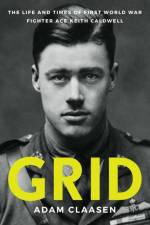
This gripping biography of Air Commodore Keith ' Grid' Caldwell CBE, MC, DFC & bar, Croix de guerre, tells the story of his remarkable exploits during the First World War. Flying single-seat fighters against the best of the German air force, including the Red Baron's Flying Circus and airmen such as Werner Voss, Caldwell accumulated 26 victories in aerial combat. Over his illustrious career he flew with numerous ' stars' of the British air service, including Albert Ball, William ' Billy' Bishop and Edward ' Mick' Mannock. In the last year of the war, aged only 22, he was given command of the new 74 Squadron. Under his leadership 74 ' Tiger' Sqaudron become one of the war's most feared and revered units. Written by a leading military historian, Grid details Caldwell's journey from early flight training in Auckland to his death-defying sorties over enemy lines on the Western Front. It also details his pivotal role in sustaining military aviation in interwar New Zealand, and his role in reinvigorating interest in the airmen of the First World War during the 1960s and 1970s.
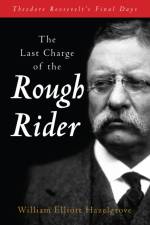
There have been many books on Theodore Roosevelt, but there are none that solely focus on the last years of his life. Racked by rheumatism, a ticking embolism, pathogens in his blood, a bad leg from an accident, and a bullet in his chest from an assassination attempt, in the last two years of his life from April 1917 to January 6, 1919, he went from the great disappointment of being denied his own regiment in World War I, leading a suicide mission of Rough Riders against the Germans, to the devastating news that his son Quentin had been shot down and killed over France. Suffering from grief and guilt, marginalized by world events, the great glow that had been his life was now but a dimming lantern. But TR's final years were productive ones as well: he churned out several "instant" books that promoted U.S. entry into the Great War, and he was making plans for another run at the Presidency in 1920 at the time of his death. Indeed, his political influence was so great that his opposition to the policies of Woodrow Wilson helped the Republican Party take back the Congress in 1918. However, as William Hazelgrove points out in this book, it was Roosevelt's quest for the "vigorous life" that, ironically, may have led to his early demise at the age of sixty. "The Old Lion is dead," TR's son Archie cabled his brother on January 6, 1919, and so, too, ended a historic era in American life and politics.
Although he has largely receded from the public consciousness, John Mitchell Jr., the editor and publisher of the Richmond Planet, was well known to many black, and not a few white, Americans in his day. A contemporary of Booker T. Washington, Mitchell contrasted sharply with Washington in temperament. In his career as an editor, politician, and businessman, Mitchell followed the trajectory of optimism, bitter disappointment, and retrenchment that characterized African American life in the Reconstruction and Jim Crow South. Best known for his crusade against lynching in the 1880s, Mitchell was also involved in a number of civil rights crusades that seem more contemporary to the 1950s and 1960s than the turn of that century. He led a boycott against segregated streetcars in 1904 and fought residential segregation in Richmond in 1911. His political career included eight years on the Richmond city council, which ended with disenfranchisement in 1896.As Jim Crow strengthened its hold on the South, Mitchell, like many African American leaders, turned to creating strong financial institutions within the black community. He became a bank president and urged Planet readers to comport themselves as gentlemen, but a year after he ran for governor in 1921, Mitchell's fortunes suffered a drastic reversal. His bank failed, and he was convicted of fraud and sentenced to three years in the state penitentiary. The conviction was overturned on technicalities, but the so-called reforms that allowed state regulation of black businesses had done their worst, and Mitchell died in poverty and some disgrace.Basing her portrait on thorough primary research conducted over several decades, Ann Field Alexander brings Mitchell to life in all his complexity and contradiction, a combative, resilient figure of protest and accommodation who epitomizes the African American experience in the late nineteenth and early twentieth centuries.
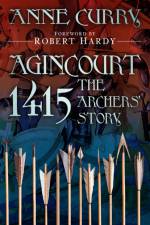
This lavishly illustrated history re-tells the story of the battle and Henry V's Normandy campaign from the perspective of the commander of the English archers, Sir Thomas Erpingham.
Abonner på vårt nyhetsbrev og få rabatter og inspirasjon til din neste leseopplevelse.
Ved å abonnere godtar du vår personvernerklæring.