









Gjør som tusenvis av andre bokelskere
Abonner på vårt nyhetsbrev og få rabatter og inspirasjon til din neste leseopplevelse.
Ved å abonnere godtar du vår personvernerklæring.Du kan når som helst melde deg av våre nyhetsbrev.

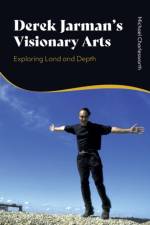
Derek Jarman's place in the history of film is assured by virtue of his vibrant, defiant films that experiment with the very process of film-making and create new forms. His paintings, their excitements and their profundity, are less well known. In this first book-length study, Michael Charlesworth sheds light on the varied ramifications of Jarman's artistic practice from his years at Prospect Cottage, Dungeness, and his interest in depth psychology. He draws on Jarman's paintings, especially his landscapes from the 1960s and 70s, his multiple series such as 'black' and 'broken glass', GBH, Queer and Evil Queen, and his last Ecstatic Landscapes (1991-3). He also showcases Jarman's excellence as a writer with respect to his memoir, Kicking the Pricks. Selecting films such as Journey to Avebury (1973), Caravaggio (1986), The Garden (1990) and Blue (1993), Charlesworth emphasizes themes and artistry rather than narrative, amounting to a novel approach to Jarman's cinema. Exploring the ways in which Jungian and post-Jungian psychology were absorbed into Jarman's varied works, Derek Jarman's Visionary Arts provides a fresh perspective on his painting, film and writing. It celebrates him as one of the major British artists of the late 20th century, engaging with current debates about queer sexualities, environmentalism and climate catastrophe.
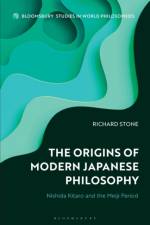
Nishida Kitaro is widely considered as the first original philosopher in modern Japan. Addressing this claim, Richard Stone critically examines Nishida's relation to his contemporary philosophers in the Meiji era (1868-1912), highlighting the continuity, difference and relationships between them.Stone reassesses the notion that Nishida's An Inquiry into the Good (1911) was substantially more philosophically worthwhile than any preceding attempts at philosophy in Japan, whilst demonstrating how his early ideas were heavily influenced by the work of thinkers such as Inoue Enryo, Onishi Hajime and Miyake Setsurei. He argues that original philosophy in Japan did not suddenly start with Nishida. Instead, it developed within a process of methodological refinement, wherein ideas starting from early Meiji philosophers were gradually given more rigorous treatment over the course of the era, eventually culminating in Nishida's early philosophy.Providing an in-depth analysis of Nishida's work that brings it into dialogue with his predecessors, The Origins of Modern Japanese Philosophy offers an engaging insight into the Meiji period as background to Nishida's philosophical formation.
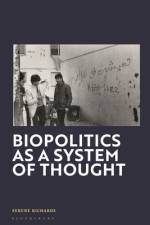
Biopolitics as a System of Thought takes seriously Foucault's claim that biopolitics is the primary technique of government, the means by which the organisation of our social relations operates. The book's main argument is that there exists a fundamental relationship between thinking and political action - understood as the capacity of transforming our existing social relations. It asks how it could be that while the material conditions of life have increasingly worsened; that we are not lacking in reasons for political mobilisations, and our capacities for effective political action appear to have diminished. Engaging with modern political discussions such as black lives matter and Roe v Wade, Serene Richards draws from jurists such as Pierre Legendre, Yan Thomas, and philosophers such as Agamben, Arendt, Esposito to explore how the same institutions that offer rights protection can easily and without much notice, take them away. She argues that a politics of destitution as opposed to constitutive power could form the basis of such a politics to come - a reappraisal of law, violence and the state to reconceptualise our social relations. One that remains institutional - for it is not a doing away with institutions all together that is in question - and adjacent to the law - for there is no outside of the law.
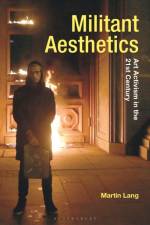
In 2008 an Iraqi artist was waterboarded as performance art. In 2010 artists upturned police cars in Russia. But what exactly do we mean by militant art and aesthetics? Bringing together the philosophy of art and politics, Martin Lang provides a comprehensive examination of militant art activism: its history, its advocates and the aesthetic theory behind it. Protest art is not a new concept and yet this book argues that after the terrorist attacks of 9/11 distinctly 21st-century forms of art activism emerged. On the one hand these became militant as artists retained belief in the possibility of radical political change through art. On the other hand, this belief developed in a hostile environment, when anti-terror legislations reclassified activists and artists as terrorists. Through first-hand interviews and experiences, Militant Aesthetics sheds light on numerous international case studies of modern art activism and the different ways they can be classified as militant. Many artists and collectives, including Grupo Etcétera in Buenos Aries, are prepared to break the law and risk arrest for their art. Others like Thomas Bresolin's Militant Training Camp utilise military uniforms in violent performances that connect with public anger, and artists such as Zthoven in the Czech Republic occupy, hack, antagonise and disrupt in increasingly militant ways. Combining these examples with the pioneering thought of Badiou, Zizek, Rancière and Mouffe, as well as up-to-date scholarship from Bishop, Léger and others, Lang investigates the instances, attributes and rules of militant art in order to introduce a new overall theory of 21st-century militant aesthetics.
Abonner på vårt nyhetsbrev og få rabatter og inspirasjon til din neste leseopplevelse.
Ved å abonnere godtar du vår personvernerklæring.