



















Gjør som tusenvis av andre bokelskere
Abonner på vårt nyhetsbrev og få rabatter og inspirasjon til din neste leseopplevelse.
Ved å abonnere godtar du vår personvernerklæring.Du kan når som helst melde deg av våre nyhetsbrev.

"Black Power, Jewish Politics expands with this revised edition that includes the controversial new preface, an additional chapter connecting the book's themes to the national reckoning on race, and a foreword by Jews of Color Initiative founder Ilana Kaufman that all reflect on Blacks, Jews, race, white supremacy, and the civil rights movement"--
"A history of childhood that revises the story of manhood, race, and human hierarchy in America"--
The Arts of Encounter uncovers the significant role of religious images in literature, offering a new approach to understanding Christian-Muslim relations in early modern Spain.
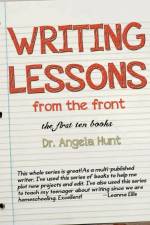
A complete writer's workshop in a book . . . The first ten Writing Lessons from the Front are compiled into this volume. Lessons cover plot structure, characterization, point of view, evoking emotion, self-editing, creating and maintaining tension, writing historical fiction, writing the children's picture book, plans and processes to get your book finished, self-publishing, and a complete writer's checklist that will take you from prewriting to publication, including details on how to publish on Kindle Direct Publishing.By Angela Hunt, who has written and published more than 150 books and taught at several major writing conferences.
"Provides strategies for research in literature, from understanding an assignment and choosing a topic to citing sources and creating a bibliography. Gives guidance on searching library catalogs, subject-specific databases, and the Internet. Offers advice on choosing keywords, evaluating online sources, distinguishing between primary and secondary sources, and making interlibrary loan requests"--
Few, if any, historians have brought such insight, wisdom, and empathy to public discourse as Jill Lepore. Arriving at The New Yorker in 2005, Lepore, with her panoptical range and razor-sharp style, brought a transporting freshness and a literary vivacity to everything from profiles of long-dead writers to urgent constitutional analysis to an unsparing scrutiny of the woeful affairs of the nation itself. The astonishing essays collected in The Deadline offer a prismatic portrait of Americans' techno-utopianism, frantic fractiousness, and unprecedented-but armed-aimlessness. From lockdowns and race commissions to Bratz dolls and bicycles, to the losses that haunt Lepore's life, these essays again and again cross what she calls the deadline, the "river of time that divides the quick from the dead." Echoing Gore Vidal's United States in its massive intellectual erudition, The Deadline, with its remarkable juxtaposition of the political and the personal, challenges the very nature of the essay-and of history-itself.
This book provides a critical introduction to the complex relationship between law and peace.
Amidst continuing debates about the literary canon, Literature, Culture and Society poses a revealing question--if academics find it valuable and stimulating to discuss texts ranging from Genesis to Bladerunner in their leisure time, why do they act as if this is sacrosanct in their formal work? In this well- argued and refreshing discussion of the history and importance of literary criticism, Milner embraces a reality that many in the academy still fear, that cultural studies is alive, and it's here to stay. Andrew Milner begins with an introduction to the field of cultural studies and its parent disciplines of English literature and sociology. He reviews the defining terms and the theoretical traditions in a manner that is sophisticated but accessible. He discusses just how and why cultural studies evolved, and what it has to offer our appraisal of all texts, be they old or new, print or film. Milner eschews both cultural populism and literary elitism in favor of a criticism that is more concerned with value than with exclusion. The author concludes this significant and insightful book with a demonstration of his theories, tying together a group of narratives ranging from Paradise Lost to the latest Frankenstein films. Literature, Culture and Society cogently examines the question of scholarship and forcefully demonstrates that rigorous academic inquiry need not be reserved for dust-covered texts alone.
What does it mean to be a Jewish woman today? To an Orthodox woman, it means living a religious way of life in which serving God totally defines her self-perception and her role as wife and mother. For the secular woman, it means having a sense of belonging, although not necessarily to a specific Jewish community. Most contemporary Jewish women fall somewhere in between, but at the core of all of their identities is a complex interweaving of religious and ethnic elements, a shared history, and a collective memory of periods of prejudice, persecution, wandering, and resettlement. Focusing on Jewish women in the United States and Britain, Adrienne Baker examines such issues as women's role in religious law, the spectrum of synagogue observance, the mother's role as conveyor of tradition, conversion and inter- faith marriages, and sexuality. In particular, the book examines the impact of feminism on Jewish women and their culture, uncovering the counterinfluences of tradition and new freedoms on women's lives.
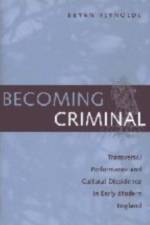
In this book Bryan Reynolds argues that early modern England experienced a sociocultural phenomenon, unprecedented in English history, which has been largely overlooked by historians and critics. Beginning in the 1520s, a distinct "criminal culture" of beggars, vagabonds, confidence tricksters, prostitutes, and gypsies emerged and flourished. This community defined itself through its criminal conduct and dissident thought and was, in turn, officially defined by and against the dominant conceptions of English cultural normality.Examining plays, popular pamphlets, laws, poems, and scholarly work from the period, Reynolds demonstrates that this criminal culture, though diverse, was united by its own ideology, language, and aesthetic. Using his transversal theory, he shows how the enduring presence of this criminal culture markedly influenced the mainstream culture's aesthetic sensibilities, socioeconomic organization, and systems of belief. He maps the effects of the public theater's transformative force of transversality, such as through the criminality represented by Shakespeare, Jonson, Middleton, and Dekker, on both Elizabethan and Jacobean society and the scholarship devoted to it.
Don DeLillo, Paul Auster, Cormac McCarthy, Rolando Hinojosa, E. Annie Proulx, Bret Easton Ellis, Douglas Coupland, and Thomas Pynchon: An Introduction to Contemporary American Fiction introduces the work of a range of key American authors, all of whom can be said to engage with postmodernism. Exploring the vitality and energy of contemporary writing in light of pessimistic proclamations on the state of postmodern American culture, Bilton highlights the tension between "realistic" description and linguistic self-consciousness in contemporary fiction. In addition, by addressing a central problem in literary theory-its neglect of literary discussion and the practice of reading-An Introduction to Contemporary American Fiction is able to present a working model for reading a text theoretically. As an introductory text, it assumes no prior knowledge of the authors of the novels discussed. To encourage understanding and aid further study, the following features are included: * GLOSSARY OF CRITICAL AND LITERARY TERMS* BIBLIOGRAPHY OF EACH AUTHOR'S WORKS* BIOGRAPHY OF EACH AUTHOR* GUIDE TO FURTHER READING* THEMATIC AND AUTHOR INDICES
This book is a reproduction of the book containing the CASE OF VENEZUELA IN THE QUESTION OF BOUNDARY BE-TWEENVENEZUELA AND BRITISH GUIANA PRESENTED BY VENE-ZUELA TO THE ARRBITRATORS IN CONFORMITY WITH THE TREATY OF FEBRUARY 2, 1897. Part II. 1898, (Translated from Spanish), Official Edition, published by the Press of Mc Grill & Wallace, Washington DC, 1898
As the choking smog settles over the bustling streets of Delhi-National Capital Region (NCR), there is an urgent need to delve into the pressing issue that has plagued the region for years: stubble burning. This book, "Stubble Burning and Its Impact on Health and Environment in Delhi-NCR," delves into the causes, consequences, and potential solutions of this harmful practice that has profound implications for both human health and the environment. The purpose of this book is to shed light on the intricate web of factors contributing to stubble burning and its detrimental effects. It aims to educate readers about the environmental and health consequences that arise from this unsustainable agricultural practice. By examining the intricate nuances of stubble burning, we hope to empower individuals, communities, and policymakers to take collective action in tackling this issue head-on. Chapter by chapter, we navigate through the intricate layers surrounding stubble burning. We begin by providing an in-depth understanding of the practice itself-its historical context, cultural significance, and the challenges faced by farmers in managing crop residue effectively. This sets the stage for a comprehensive exploration of its impact on human health, where we delve into the increased cases of respiratory diseases and the vulnerable groups most affected. The book does not stop there; it also sheds light on the economic and social implications of stubble burning. We explore the far-reaching consequences on various sectors, such as tourism, productivity, and investment, while also considering the effects on the quality of life for the people living in the region. By examining the costs associated with this practice, we aim to demonstrate that addressing stubble burning is not only a matter of environmental concern but also an imperative for sustainable development. We then shift our focus towards government initiatives and policies in place to combat stubble burning. By analyzing the effectiveness of current measures, we identify opportunities for improvement and propose potential solutions to achieve a significant reduction in stubble burning. However, we believe that the responsibility lies not solely on the shoulders of the government but also on the collective efforts of communities and individuals. We highlight the importance of grassroots movements, community-driven initiatives, and individual actions in fostering sustainable agricultural practices. Moreover, this book aims to broaden the perspective by exploring international best practices and experiences. By examining successful approaches from around the world, we hope to inspire innovation and collaboration, fostering a global community committed to addressing the challenges of stubble burning. In the end, we look towards the future, offering a glimpse of hope and possibilities. We emphasize the importance of sustained efforts, education, and awareness in bringing about a positive change. It is our sincere belief that by raising awareness and presenting evidence-based solutions, we can drive the transformation needed to overcome the detrimental impacts of stubble burning and create a healthier, greener, and more sustainable future for Delhi-NCR. In closing, we extend our gratitude to all the individuals, organizations, and experts who have contributed to the knowledge and insights presented in this book. It is our collective responsibility to act and strive for a future where the skies above Delhi-NCR are clear and the air we breathe is safe for generations to come. Let us embark on this journey together.
Esta Tercera Edición del DICCIONARIO DE DERECHO ADMINISTRATIVO ECUATORIANO contiene la pertinente legislación actualizada al 31 julio del 2023; por el extenso contenido lo presentamos en dos volúmenes. Al final de la obra insertamos el Sumario en orden alfabético.Hacemos el compromiso de mantenerlo permanentemente actualizado conforme se promulguen reformas legales.En próximas ediciones aspiramos a enriquecerlo con adición de doctrina y jurisprudencia.
Esta Tercera Edición del DICCIONARIO DE DERECHO ADMINISTRATIVO ECUATORIANO contiene la pertinente legislación actualizada al 31 julio del 2023; por el extenso contenido lo presentamos en dos volúmenes. Al final de la obra insertamos el Sumario en orden alfabético.Hacemos el compromiso de mantenerlo permanentemente actualizado conforme se promulguen reformas legales.En próximas ediciones aspiramos a enriquecerlo con adición de doctrina y jurisprudencia.
Every day, often without realizing it, we enter into contractual agreements - from purchasing a loaf of bread at the bakery to buying a property. You might wonder, what is the purpose of contracts, and how are their terms established? If you're uncertain, this book is for you. Many people skim through contracts without truly understanding their content, leading to significant negative consequences for those involved. Some don't even bother reading the documents at all, thereby leaving themselves vulnerable. This practical guide is designed to help you grasp the fundamentals of reading and understanding contracts. It also delves into the limitations that laws and legal precedents impose on contractual freedom. If you're unfamiliar with the intricacies of contractual agreements, this guide is for you. Don't hesitate to read it, as it will enlighten you about this powerful tool for facilitating economic exchange known as contracts.
"Psicologia Oscura: El Arte de la Manipulación" sumerge a los lectores en el intrigante mundo de la psicologÃa oscura, revelando cómo estas tácticas son hábilmente aplicadas por espÃas y operadores de inteligencia. El autor, Jorge Polo, fusiona su experiencia en agencias estatales y su conocimiento profundo en seguridad para desentrañar los secretos detrás de la manipulación psicológica.Puntos Destacados: Exploración Profunda: El libro va más allá de la superficie, explorando los fundamentos de la psicologÃa oscura, desde sus orÃgenes hasta su aplicación práctica en situaciones de inteligencia.Técnicas EspecÃficas: Detalla técnicas especÃficas de influencia, persuasión y manipulación emocional utilizadas por espÃas, respaldadas por ejemplos históricos y estudios de caso.Aplicación en el Espionaje: Cada concepto se presenta en el contexto del espionaje, proporcionando una comprensión única de cómo estas estrategias se despliegan en situaciones del mundo real.Desglose del Control Mental: Se adentra en el espinoso territorio del control mental y el lavado de cerebro, ofreciendo una visión completa sin profundizar demasiado, reservando espacio para futuros desarrollos.Enfoque Ãtico: A lo largo del libro, se destaca la importancia de un enfoque ético en el uso de estas técnicas, subrayando la necesidad de conciencia y responsabilidad.Prácticas Actuales: Examina las técnicas contemporáneas de infiltración, creación de identidades falsas, y su aplicación en un mundo impulsado por la información.Habilidades de Protección: No solo revela las tácticas utilizadas, sino que también equipa a los lectores con estrategias para protegerse contra la manipulación psicológica.Contribución del Autor: Jorge Polo, reconocido experto en seguridad y exmiembro de agencias estatales, ofrece una perspectiva auténtica y experta. Su experiencia en asesorar a corporaciones y gobiernos se refleja en cada página, brindando una guÃa valiosa para aquellos que buscan comprender y resistir la psicologÃa oscura.Destinatarios: Este libro es esencial para aquellos interesados en la psicologÃa, inteligencia y seguridad. Desde el estudiante curioso hasta el profesional experimentado, cada lector encontrará una rica fuente de conocimientos y reflexiones éticas en "Psicologia Oscura: El Arte de la Manipulación".
La familia constituye el núcleo de la sociedad, es por ello que cuando se decreta la disolución del vÃnculo matrimonial, invariablemente el juez deberá resolver las cuestiones familiares relacionadas con la guarda y custodia de los hijos, el régimen de convivencias con el padre no custodio, los alimentos, la pensión compensatoria, entre otros. El establecimiento del derecho de visitas en la legislación se justifica plenamente, ya que al convivir se propician el trato y la calidez humana, las personas se ven, platican, se brindan afecto y se conocen mejor, por lo que con la convivencia se fortalecen sentimientos afectivos que colman los fines de la institución familiar, pues los acercamientos de las personas son esenciales para alcanzar su tranquilidad, felicidad y armonÃa personal, familiar y social, sobre todo cuando se trata de menores. Sin embargo, ante la existencia de situaciones en donde los desacuerdos personales hacen imposible la convivencia entre los progenitores, el Estado se encuentra obligado a encontrar mecanismos que garanticen el derecho de los menores de edad a mantener relaciones personales y de trato directo con cada uno de sus padres de forma regular, asegurando asà la continuación de la convivencia familiar. Lo anterior, a efectos de asegurar la continuidad de las relaciones personales entre los menores y el progenitor no custodio, sus abuelos y otros parientes o allegados. De manera que, al implementar el régimen de convivencia, la autoridad judicial debe considerar el principio del interés superior del menor, al tratarse de un derecho a favor de los menores de edad, independientemente de los intereses o derechos de cualquiera de los padres; es decir, el derecho de visitas, no está sujeto a la decisión arbitraria de cualquiera de los padres sino que, atendiendo a las circunstancias de cada caso en concreto, podrá estar limitado de forma temporal, espacial e inclusive modal, para asegurar el bienestar y estabilidad emocional de los menores involucrados. Atento a lo cual, todas las medidas sobre el cuidado y educación de los hijos deben ser adoptadas teniendo en cuenta el interés superior de éstos, que no el de los padres, pues no son las condiciones psicológicas o afectivas de los progenitores las que determinan las medidas a adoptar, sino exclusivamente el bien de los hijos. Por lo anterior, las niñas, niños y adolescentes tienen derecho a recibir orientación, educación, cuidado y disciplina de su madre, su padre o de quienes ejerzan la patria potestad, tutela o guarda, custodia y crianza, asà como de los encargados y el personal de instituciones educativas, deportivas, religiosas, de salud, de asistencia social, de cuidado, penales o de cualquier otra Ãndole, sin que, en modo alguno, se autorice a estos el uso del castigo corporal ni el trato humillante. En el presente esfuerzo académico, abordaremos la concepción de esta figura jurÃdica, asà como la forma en que deberán ventilarse ante el Ãrgano Jurisdiccional los temas inherentes al interés superior del menor, asà como lo referente a la custodia compartida, el derecho del infante a vivir en familia, asà como la opinión que éste tenga con respecto a uno u otro progenitor, el maltrato infantil y la alienación parental.
Este libro ofrece una exhaustiva exploración de la metodologÃa detrás de la elaboración de normas jurÃdicas, proporcionando a abogados y operadores jurÃdicos una guÃa esencial para entender y aplicar efectivamente el proceso normativo. El autor, un experto en derecho legislativo, examina cada fase del ciclo de vida de una norma, desde la identificación de la necesidad legislativa hasta su promulgación y aplicación. La obra comienza con un análisis detallado de las fuentes del derecho y la importancia de la coherencia y cohesión en la elaboración de normas. Se adentra en las distintas técnicas legislativas y estrategias de redacción, destacando la necesidad de claridad y precisión en la redacción normativa. A lo largo del texto, se ilustran conceptos clave con ejemplos prácticos y casos reales, proporcionando una comprensión práctica de los principios teóricos. Uno de los puntos destacados del libro es su enfoque en la participación de las partes interesadas y el análisis del impacto normativo. El autor defiende la importancia de la transparencia y la participación ciudadana en el proceso legislativo para fortalecer la legitimidad de las normas. Además, el libro aborda la adaptabilidad y actualización de las normas en respuesta a los cambios sociales y tecnológicos. Proporciona herramientas y enfoques para evaluar la efectividad de las normas existentes y sugiere estrategias para la reforma legislativa. En última instancia, se presenta como una herramienta indispensable para abogados y operadores jurÃdicos que buscan no solo comprender la complejidad del proceso legislativo, sino también mejorar la calidad y eficacia de las normas que rigen la sociedad. Este libro sirve como una brújula práctica para aquellos comprometidos con la creación y aplicación de normas jurÃdicas que respeten los principios fundamentales del Estado de Derecho.
Orthodontic bio-materials are made up of metal alloys, polymers, and composites. Each materials have their own advantages and disadvantages over the other. Interestingly none of the materials have all the ideal properties together. To overcome the disadvantages, a marked improvement in science and technology and materials helped to improve the material properties. Thus as long as humans thrives for excellence their search and betterment towards bio-materials will continue forever.
En el dinámico mundo empresarial de hoy, la eficiencia es la clave para el éxito sostenible. La capacidad de establecer y comunicar normas empresariales de manera efectiva a sus colaboradores internos y externos es un factor fundamental en la creación de una operación ágil y orientada a resultados.Este libro, titulado "Normas Empresariales Internas: El motor oculto de la productividad y la rentabilidad", invita a propietarios de empresas, directores y responsables de la construcción de la normativa interna empresarial, a explorar el arte de formular normas que impulsen la productividad y la cohesión en tu organización.A lo largo de estas páginas, descubrirás, qué son los costos ocultos, y cómo se generan en el ámbito laboral, operativo y de ventas por una deficiente estructura de regulación interna.Asà también, conocerás cómo las normas internas pueden apoyar el desarrollo y posicionamiento de tu empresa en el mercado, eliminando antiguas prácticas estructurales mediante estrategias y técnicas prácticas para redactar normas que no solo cumplan con los estándares de la empresa, sino que también inspiren un compromiso genuino por parte de tu equipo.Acompáñanos en este viaje hacia una nueva manera de observar la optimización empresarial, donde cada palabra y cada directriz interna se convierten en cimientos sólidos para un crecimiento constante.Desde la definición de objetivos hasta la implementación de polÃticas, este libro te brinda las herramientas necesarias para transformar tus normas empresariales en una verdadera ventaja competitiva.Prepárate para encontrar en su interior cómo las normas empresariales internas pueden convertirse en tu mayor ventaja dentro de un mercado que cada vez exige mejores resultados a menor costo. ¡No te pierdas la oportunidad de transformar tu negocio y superar a la competencia!
Abonner på vårt nyhetsbrev og få rabatter og inspirasjon til din neste leseopplevelse.
Ved å abonnere godtar du vår personvernerklæring.