


























Gjør som tusenvis av andre bokelskere
Abonner på vårt nyhetsbrev og få rabatter og inspirasjon til din neste leseopplevelse.
Ved å abonnere godtar du vår personvernerklæring.Du kan når som helst melde deg av våre nyhetsbrev.

A mixture of strategic insight and practical tools, Blackstone's Counter Fraud Professional's Handbook is a guide to the various approaches to counter fraud. Developed by experts in the field with years of experience, both new and established practitioners will find insight and consolidate their existing knowledge by referencing this volume.
The only manuals supporting students on Bar courses, providing detailed coverage of the key laws, rules and procedures alongside practical exercises.
This book presents the major achievements of contemporary civil law jurisprudence to the common law world, bridging the gap in analytic jurisprudence as it is currently practiced in the two traditions.
"This book addresses the regulation of hybrid warfare under relevant branches of international law, beginning with the law on inter-state use of force (jus ad bellum). It assesses the extent to which forms of hybrid warfare comply with or violate international humanitarian law/the law of armed conflict. It then looks at law enforcement action in response to hybrid warfare, both on land and on the high seas, and goes on to tackle the constraints applied to hybrid warfare under international human rights law. The final two chapters look at accountability for the conduct of hybrid warfare"--
Can the law keep up with AI? This book examines liability and regulation for artificial intelligence causing serious physical harm, both now and in the future. While AI moves quickly, regulation follows more slowly - an increasing problem for an evolutionary, fast-paced emerging technology. AI has the potential to save lives, but in doing so will have the potential to take them as well. How do we future-proof law and regulation to incentivise life-saving innovation as safely as possible? This book details how to regulate AI in high-risk civil applications (for example, automated vehicles and medicine), addressing both liability and regulatory structure. It highlights crucial liability themes for technology governance; provides tools to bridge the gap between regulators and technologists; examines jurisdictional approaches to AI regulation in the EU, UK, USA, and Singapore; and ultimately suggests a jurisdiction-agnostic blueprint for regulation.
A collection of essays from Dieter Grimm, Germany's most renowned constitutional scholar, shining a light on the jurisprudence of the German Constitutional Court and constitutional adjudication in general. Established in 1951, the court has become a blueprint for new courts ever since and its jurisprudence, particularly in the field of fundamental rights, has influenced the decisions of judges throughout the world. After the seismic constitutional changes of the years 1989-90 in Germany and beyond, many countries adopted new democratic constitutions and established constitutional courts in order to make their constitutions effective. Today, many of these courts are under attack both politically and intellectually. In this book, Grimm considers some of the fundamental questions under academic scrutiny today: are constitutional courts political or legal institutions? Is judicial review a political or a legal activity? Is it a threat to, or a condition, of democracy? Should these courts be abolished or strengthened? Is a rational interpretation of constitutional law possible? The essays provide answers to these questions and describe how constitutional courts work if they properly fulfill their function of enforcing the constitution. A special emphasis is put on the importance of constitutional interpretation: something, the author argues, that most critics of constitutional adjudication neglect.
The rule of law, or Rechtsstaatsprinzip, is one of Germany's oldest constitutional principles and forms part of Germany's constitutional self-understanding. This book critically examines to what extent this key constitutional principle has translated into a reality for all.The book provides a comprehensive insight into rule of law experiences and discourses in Germany. It explores Germany's long rule of law tradition and highlights where the German state has fallen short of its rule of law promise, using historical and contemporary examples. It also shows that Germany's rule of law experience is tightly interwoven with European and international rule of law debates. By integrating historical, socio-legal, and doctrinal perspectives, the book provides a nuanced account of a foundational principle in German constitutional thought.Dedicated chapters explore the history and doctrine of the rule of law, challenges to the rule of law in today's Germany, the rule of law experience in the former German Democratic Republic and in the context of reunification, the relationship of the German rule of law practice with the rule of law on the European and international level, and the rule of law in times of crisis. This includes challenges to the rule of law through anti-terrorism measures, as well as the more recent COVID-19 pandemic and the so-called migration crisis, but also how the rule of law has been discursively (mis-)used in those situations. In concluding, the book highlights digitalisation as a challenge to the future of the rule of law in Germany.
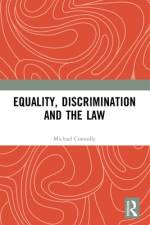
Equality, Discrimination and the Law argues that the traditional notions of discrimination and victimisation are inadequate to implement equality policy and cannot represent fully the reality of discriminatory practices.
Childhood in Liberal Theory offers a novel perspective on the concept of 'childhood' and children's rights within the tradition of liberal theories of justice. Brando questions the strict opposition of childhood and adulthood as social categories, and proposes an Adaptive model of childhood as an alternative foundation.
Investigates the elements in the legal and organizational context relevant for police response to incidents in the realm of the private sphere and whether there exists a relation with the reporting of such incidents by victims. This book addresses issues in the relationship between the response to family violence and the reporting by victims.
This book hinges on 3 broad but interlinked elements: sustainable development as a concept, sustainable development in the Global South, and implementation challenges. The advent of the Sustainable Development Goals and the 2030 Agenda have contributed to the deepening of the concept of sustainable development within global and national policy schemes. The fact that sustainable development is crucial for our very survival is no longer a contested issue; rather, the key concern now is how this can be achieved equitably by reconciling competing priorities and concerns of the Global South and the Global North. While the Global South are eager to adopt and integrate the 2030 Agenda in their respective policy frameworks, local contexts are often at odds with the global model of sustainable development. The book examines national capacities and institutional arrangements in countries in the Global South. It considers the challenges of integrating sustainable development in national policy frameworks. This includes the role, interactions, and inter-dependence of different branches of international law in, inter alia, protecting human rights, promoting access to justice, ensuring environmental justice, guaranteeing social protection, and safeguarding the rule of law for sustainable societies. This book explores the emerging patterns and processes of development projects that have either succeeded or failed, critical reflections on what has been achieved and whose interests they served, and the costs and benefits of particular interventions.
Discrimination in Housing Law is a concise but authoritative guide to the use of equality principles in housing law, together with practical guidance for any practitioner bringing or defending such a claim.
This book is an essential guide for all solicitors and compliance officers working in this specialised and ever-evolving area of law.
This volume offers a comprehensive account of the concept of 'family' in EU law and its role in regulating relationships and shaping policies from various disciplinary perspectives. The result is an exciting mix of doctrinal and theoretical approaches which uncover crucial preconditions and determinants for family life under EU law.
Remedies ensures that trainee barristers can correctly identify remedial relief and calculate damages for their clients. Combining explanations of substantive law with problems and worked examples, trainee barristers are encouraged to apply their knowledge and find practical solutions to problems likely to be encountered in practice.
The only manuals supporting students on Bar courses, providing detailed coverage of the key laws, rules and procedures alongside practical exercises.
Professional Ethics provides an excellent introduction to the fundamental rules and principles of professional conduct and ethical considerations essential to maintaining the high professional standards of the practising Bar. For ease of reference, the revised Code of Conduct is included in the manual in full.
Opinion Writing and Case Preparation equips trainee barristers with the tools and techniques they need to identify, analyze, and present sound legal arguments, and provides them with a thorough grounding in the skill of writing opinions.
This manual offers a comprehensive course in drafting suitable for the trainee barrister, providing all the necessary information alongside practical exercises to help the reader practise and master the skill of drafting.
Covering all aspects of a client interview in both civil and criminal proceedings, Conference Skills equips trainee barristers with the key case-work, written, and interpersonal skills required to conduct successful client conferences, and is fully supported by how-to-do-it guides, worked examples, and realistic case documentation.
Advocacy provides a highly practical introduction to the skills and techniques required to deliver submissions and applications in the courts. It covers the full range of courtroom transactions from opening and closing cases, to conducting examination-in-chief, cross-examination, and questioning witnesses.
This book argues that equal recognition before the law is the key to achieving social equality for marginalised groups. It examines how the law denies equal recognition to members of marginalised groups through denials of their legal personhood and legal agency and how we can use human rights law to address these wrongs.
Lava Jato, the largest transnational bribery case in history, shocked Latin American politics. This book explains why the investigation gained momentum in some countries, becoming an anti-corruption crusade. It examines public reactions, finding that prosecutors' unprecedented zeal eroded the tacit consensus around the merits of anti-corruption.
Abonner på vårt nyhetsbrev og få rabatter og inspirasjon til din neste leseopplevelse.
Ved å abonnere godtar du vår personvernerklæring.