





















Gjør som tusenvis av andre bokelskere
Abonner på vårt nyhetsbrev og få rabatter og inspirasjon til din neste leseopplevelse.
Ved å abonnere godtar du vår personvernerklæring.Du kan når som helst melde deg av våre nyhetsbrev.

How human institutions-markets, states, communities, religions, guilds and families-have helped both to control and to exacerbate epidemics throughout history. How do societies tackle epidemic disease? In Controlling Contagio, Sheilagh Ogilvie answers this question by exploring seven centuries of pandemics, from the Black Death to Covid-19. For most of history, infectious diseases have killed many more people than famine or war, and in 2019 they still caused one death in four. Today, we deal with epidemics more successfully than our ancestors managed plague, smallpox, cholera or influenza. But we use many of the same approaches. Long before scientific medicine, human societies coordinated and innovated in response to biological shocks-sometimes well, sometimes badly. Ogilvie uses historical epidemics to analyze how human societies deal with "externalities"-situations where my action creates costs or benefits for others beyond those that I myself incur. Social institutions-markets, states, communities, religions, guilds, and families-help us manage the negative externalities of contagion and the positive externalities of social distancing, sanitation, and immunization. Ogilvie shows how each institution enables us to coordinate, innovate and inspire each other to limit contagion. But each institution also has weaknesses that can make things worse. Markets shut down voluntarily during every epidemic in history-but they also brought people together, spreading contagion. States mandated quarantines, sanitation, and immunization-but they also waged war and censored information, exacerbating epidemics. Religions admonished us to avoid infecting our neighbours-but they also preached against science and medical innovations. What decided the outcome, Ogilvie argues, was a temperate state, an adaptable market, and a strong civil society where a diversity of institutions played to their own strengths and checked each other's flaws.
An intimate account of the eighteenth-century Bank of England that shows how a private institution became "a great engine of state"The eighteenth-century Bank of England was an institution that operated for the benefit of its shareholders-and yet came to be considered, as Adam Smith described it, "a great engine of state." In Virtuous Bankers, Anne Murphy explores how this private organization became the guardian of the public credit upon which Britain's economic and geopolitical power was based. Drawing on the voluminous and detailed minute books of a Committee of Inspection that examined the Bank's workings in 1783-84, Murphy frames her account as "a day in the life" of the Bank of England, looking at a day's worth of banking activities that ranged from the issuing of bank notes to the management of public funds. Murphy discusses the bank as a domestic environment, a working environment, and a space to be protected against theft, fire, and revolt. She offers new insights into the skills of the Bank's clerks and the ways in which their work was organized, and she positions the Bank as part of the physical and cultural landscape of the City: an aggressive property developer, a vulnerable institution seeking to secure its buildings, and an enterprise necessarily accessible to the public. She considers the aesthetics of its headquarters-one of London's finest buildings-and the messages of creditworthiness embedded in that architecture and in the very visible actions of the Bank's clerks. Murphy's uniquely intimate account shows how the eighteenth-century Bank was able to deliver a set of services that were essential to the state and commanded the confidence of the public.
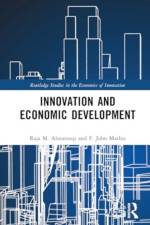
The expansion of multinational corporations, dependence on global supply chains, and globalization have aided the rising expansion of Innovations worldwide. The book analyzes the drivers and relationship between these increasingly dispersed Innovations and the expanding linkage between economic growth in developed and developing countries.
"Nanotechnology for Environmental Management" is your gateway to the latest advancements in environmental science and technology. Edited by leading international scientists, this book delves into the diverse approaches and applications of nanomaterials and nanotechnologies.
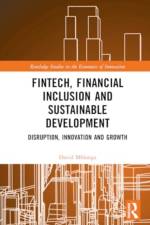
This book explores the significant impact of FinTech on the financial industry and how it could be used to promote legitimate development in the global economy. It takes readers on an engaging tour of the field of FinTech, immersing them in an investigation of the advancements, business models, and issues that define the FinTech landscape.
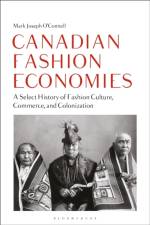
A vital re-examination of Canadian cultural and commercial history told through key fashion objects from First Nations, colonial settlers, and contemporary Canadian culture.Traditional narratives of fashion tend to ignore sophisticated pre-colonial networks, First Nation innovations and techniques, and their contributions to colonial dress. From exquisite Chilkat weavings to the iconic Hudson's Bay Company blanket coat, by way of ribbon skirts, quilts, and a beaver-fur top hat, this rich study uses Canadian fashion objects as a research tool to illuminate neglected areas in North American fashion history.Using vivid object-based research, O'Connell maps out pre-colonial economic networks spanning the entire continent, global colonial textile and fur trades, and the material culture of French and English migrant populations in the 'New World', and equips readers with a framework for more nuanced and inclusive histories of Canadian culture and commerce.Unexpected, overlooked stories emerge as central to Canada's fashion history, from hybrid fashion cultures to re-used textiles in settler communities, and O'Connell highlights contemporary Canadian artists and designers who point to new possibilities to reclaim and preserve this cultural heritage.
This book delves into the neglected potential for mitigating regional disparities, conducting a meticulous examination of environmental disparities, economic imbalances, and overarching social inequalities in Southern European regions.
Das akademische Potenzial des Rechtsgüterbegriffs, der sich seit dem Aufkommen der Risikogesellschaft in einer Krise befindet, mag im digitalen Zeitalter gänzlich verloren gegangen sein. Doch die angloamerikanische politische Freiheitsphilosophie hat sich als unerwarteter Verbündeter zur Unterstützung seiner These erwiesen. So wie die personale Rechtsgutslehre in den 1990er Jahren als Reaktion auf Joel Feinbergs Neuinterpretation des Schadensprinzips, einer getreuen Wiederherstellung des klassischen Liberalismus von John Stuart Mill, wieder an Bedeutung gewann, könnte die frische Definition der negativen Freiheit, die aus dem neo-römischen Republikanismus von Philip Pettit stammt, einen Durchbruch für die heutige Krise der Rechtsgutslehre bedeuten. So wie das Konzept der negativen Freiheit ein ewiges Licht in der politischen Philosophie ist, so ist der Wert des liberalen Strafrechts, auch wenn es sich nicht auf die utilitaristische Tradition stützt, hinter dem Schutzschild des personalen Rechtsgutsbegriffs immer für eine neue Debatte bereit.
Wenn man, wie Christoph Geyer, über 40 Jahre an der Börse ist, bleibt es nicht aus, dass man Fehler macht oder auch bewusst getäuscht wird. Alle Fehler, die Christoph Geyer selbst gemacht hat, sind in diesem Buch aufgeführt. Aber auch die Fehler die andere gemacht haben, berücksichtigt er. Er beschreibt die Fallstricke, die auf Anleger lauern und gibt Hinweise, wie sie umgangen werden können. Konkrete Vorschläge zeigen, wie man sich richtig verhalten sollte um Fehler zu vermeiden.Es geht um technische Dinge, wie Order oder den Umgang mit Brokern ebenso wie um den Umgang mit Aussagen, die man tätigt und mit wem man was besprechen darf und mit wem nicht. Auch kritische Themen werden behandelt, die sicher nicht jedem gefallen dürften, wie zum Beispiel dem Umgang mit Gebühren und versteckten Gebühren. Die Liste der möglichen Fehlerquellen ist sehr lang. "Survival Guide Börse" ist ein weit gehendes Nachschlagewerk, das Anlegern hilft, bei der Aktienanlage, beim Trading oder auch bei der Investition in einem ganz banalen Festgeldkonto möglichst viele Fehler zu vermeiden.
Details sustainable marketing, and the promotion of environmentally and socially responsible products, practices, and brand values. Explores integrating sustainability into a marketing strategy and how to develop, broaden, and maintain an effective sustainable marketing strategy. Connects marketing, consumption, and sustainability.
This volume provides a significant new commercial perspective on contraception in modern Britain. It is the first book-length study to examine contraceptives as commodities and to demonstrate the significance of the contraceptive industry in shaping sexual knowledge alongside the medical profession, the birth control movement, and the state before the emergence of the contraceptive pill. -- .
First published in 1960, Pilkington Brothers and the Glass Industry is a comprehensive economic history of the glass industry in Britain. It charts the story of Pilkington Brothers and the manufacture of window and plate glass in Britain up to 1914. The epilogue discusses the events that impacted the glass industry from 1914-1959.
The enormous range of contexts in Africa - social, economic, political, cultural, and environmental - limits the value of the search for universal solutions to endemic problems. First published in 1992, Development from Within examines an alternative framework, arguing for flexibility and specificity.
Empirical studies conducted in this book provide nuanced analysis of social-economic, administrative and political dynamics on the land beyond the airport grounds, such as the project area of Greenfield development, the airport city, or land resources reserved for future airport expansion.
This book seeks to understand how the economic construction of the Democratic People's Republic of Korea (DPRK) evolved, shaped by the formulation and execution of various economic management systems spanning the years 1949 to 2023, in response to numerous challenges faced by the country.
This book investigates the reasons why regional integration in East Asia has been much weaker than in other parts of the world. It focuses on economic factors, examining the economies of countries in the region, the linkages between them and between other parts of the world, and the economic sectors which are strong in East Asia.
This multidisciplinary, edited volume examines higher educations' ICT integration in Africa, contributing a new and inclusive change readiness framework to better understand how to manage ICT or other technological disruptions in resource-restrained contexts.
This book assembles contributions from various fields to address key aspects in the use of international sanctions, providing readers with an interdisciplinary perspective. Each part of the book is devoted to three main themes: legality and legitimacy; extraterritorial implications; and effectiveness.
Due to the absence of due process and other procedural guarantees generally offered by judicial enforcement, informal debt collection practices (IDCPs) can become abusive, harming both consumers and the economy by threatening consumers' physical, psychological, and economic wellbeing.
Abonner på vårt nyhetsbrev og få rabatter og inspirasjon til din neste leseopplevelse.
Ved å abonnere godtar du vår personvernerklæring.