






Gjør som tusenvis av andre bokelskere
Abonner på vårt nyhetsbrev og få rabatter og inspirasjon til din neste leseopplevelse.
Ved å abonnere godtar du vår personvernerklæring.Du kan når som helst melde deg av våre nyhetsbrev.

The world today is driven by Industry 4.0, which is generating data at an uncontrolled pace. This book examines Big Data and its applications. It emphasizes how Big Data is transforming Industry 4.0. It also examines systems architectures and complementary technologies including IoT, AI, and machine learning.
The Routledge Handbook of Contemporary Brunei presents an overview of significant themes, issues, and challenges pertinent to Brunei Darussalam in the twenty-first century.
The Military Balance 2025 provides the authoritative open-source assessment of the armed forces and equipment inventories of over 170 countries, with accompanying defence economics data.
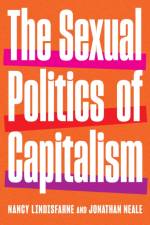
A vast and fascinating chronicle of how gender and sexuality has been used to divide people over the last fifty years The Sexual Politics of Capitalism offers a groundbreaking examination of how the global elite has used gender, sexuality, and violence to perpetuate inequality and maintain control. Since the 1980s, class elites have widened the gap between the rich and poor, manipulating these intimate aspects of life to divide communities and weaken resistance. Anthropologist Nancy Lindisfarne and writer Jonathan Neale trace the devastating effects of these tactics, showing how issues of gender and sexuality have been weaponized to make inequality appear inevitable. This compelling narrative exposes the deliberate strategies that keep the powerful in power and the marginalized fighting for survival. Spanning the globe, Lindisfarne and Neale explore the lived experiences of those on the front lines of this struggle. From mass incarceration in the United States to the resilience of queer communities in China, from Black women's battles for AIDS medication in South Africa to the fight against toxic masculinity in world leaders like Putin, Modi, Trump, and Netanyahu, this book provides a sweeping yet deeply personal account of resistance. The authors draw connections between diverse movements--union women in Nicaragua, farmers' widows in India, and bar workers in Vietnam--showing how global forces of capitalism exploit gender and sexuality to maintain power. At the same time, The Sexual Politics of Capitalism shines a light on the ongoing revolts against sexual harassment, rape, and reproductive injustice, as well as the fight for trans rights in the United States. With meticulous research and a passionate call for change, The Sexual Politics of Capitalism is more than a history--it is a manifesto for liberation. The authors invite readers to feel the grief and rage sparked by decades of oppression but also the solidarity and hope inspired by the global movements rising up in response. This radical work challenges us to confront the intimate and structural forces shaping our world and to join the fight for a more just and equitable future.
Applying two-level game theory and rational decision-making analysis, the book explores how China navigates domestic constraints and international pressures to achieve optimal outcomes in its foreign trade policy.
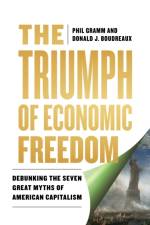
Since the Industrial Revolution, capitalism has unleashed unimaginable opportunity and prosperity. However, at key points, economic disruption has led to a greater role for government to protect against capitalism's excesses. Gramm and Boudreaux argue that government interference and policies pose the most significant threat to economic freedom.
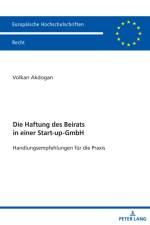
In der Praxis haben sich vielfältige Formen von Beiräten entwickelt, die teils aufsichtsratsähnlich sind, teils aber auch grundlegende Unterschiede aufweisen. Gesetzliche Vorgaben gibt es insoweit nicht.Die Gründe für die Einrichtung von Beiräten sind mannigfaltig. Es kann darum gehen, die Gesellschaft in der Außendarstellung mit den Namen bekannter Persönlichkeiten zu "schmücken" oder Fachkompetenz zu bündeln, die der Geschäftsführung zur Verfügung steht. Bei den vom Autor untersuchten Start-ups spielen Beiräte eine große Rolle, um die Interessen von Investoren und Kreditgebern abzusichern. Die praktische Bedeutung der Beiräte nimmt aktuell kontinuierlich zu.Die Vielfalt der Anlässe und Gestaltungsmöglichkeiten bringt es neben dem gesetzlichen Regelungsverzicht mit sich, dass viele Fragen rund um die Beiräte nicht abschließend geklärt sind. Zu diesen Fragen zählen namentlich auch die Haftungsfragen. Dieses Buch weist Aktualität und hohe praktische Relevanz auf.
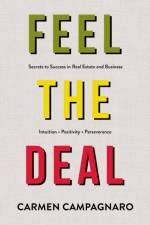
Feel the Deal is a lesson for excelling in business and overcoming adversity, showcasing success in real estate and entrepreneurship.>Learn to: Trust Your Intuition and Harness Positivity Integrity Creates Win-Win Outcomes Perseverance Turns Obstacles into Opportunities>Carmen Campagnaro is an established entrepreneur and visionary within the real estate industry, starting at just 18. As the Founder and President of an investor-focused mortgage brokerage, she has arranged in excess of $3 billion in mortgage funding with both private and institutional lenders. Carmen has also co-founded and runs a private successful real estate investment trust, a popular luxury vacation rental business, and serves as Co-Host of a nationwide real estate talk show.
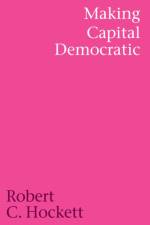
The "software" that structures our financial systems and, through them, the broader economy, is made up of certain basic concepts that guide how we think. These concepts include money, finance, investment, credit, and - above all - capital. This conceptual software manifests itself in our current "operating system" of institutions and practices. But our concepts and the system itself are radically out of date as representations of monetary, financial, productive and distributive reality. Robert Hockett shows that this mismatch has serious consequences and argues that it's time for a complete overhaul of our economic understanding.The underlying conceptual problem, Hockett contends, is that we miss the extent to which our financial systems are deeply and ineradicably public. Money is an inherent emanation of our basic social contract; capital in turn emerges as almost entirely publicly generated. Our systems of finance and investment must therefore be publicly and democratically determined. Leaving them in the hands of private powers means resigning ourselves to current health and income inequalities, ever-more-frequent financial crises, and economic stagnation and decline - to say nothing of social and political deterioration across the developed world.Lucid and passionately argued, Making Capital Democratic is a seamless blend of philosophy and economics that calls for profound intellectual and institutional changes that would befit a democracy that is democratic in more than just name.
The book offers a theoretical and practical analysis of the contemporary approach to art, culture and innovation, with special emphasis on the relationship between culture, innovation and the economy, in the context of green transition as an indispensable sustainability factor.
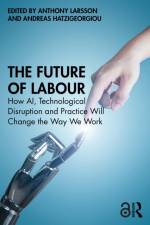
This book offers a forward-looking exploration of how AI, digitalisation and technological transformation are reshaping the future of work. Through a series of studies conducted by scientists and industry professionals, it explores issues related to new policies, AI and the digital transformation's anticipated impact on the labour market.
This book offers a forward-looking exploration of how AI, digitalisation and technological transformation are reshaping the future of work. Through a series of studies conducted by scientists and industry professionals, it explores issues related to new policies, AI and the digital transformation's anticipated impact on the labour market.
First published in 1989, The Competitiveness of European Industry helps in developing our understanding of the process of improving and measuring industrial competitiveness.
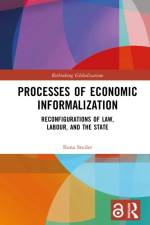
Grounded on an analysis of informalized labour in the urban economy of Dar es Salaam, Processes of Economic Informalization explores the conceptual politics involved in the political construction of the informal economy - diverse economic activities that are not regulated or protected by the state.
Order and Rivalry traces the formation and development of multilateral trade structures in the aftermath of the First World War in response to the marginalization of Europe in global markets, the use of private commerce as a tool of military power and the collapse of empires in Central and Eastern Europe.
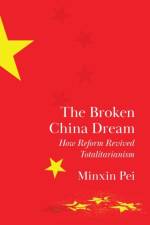
A provocative book that demystifies China’s great democratic leap backward under Xi Jinping, revealing why the country’s embrace of capitalism has given rise to hard authoritarianism, mass surveillance, and one-man rule instead of democracy as many in the West had hopedWhen China embarked on its transformative journey of modernization in 1979, many believed the country’s turn toward capitalism would put its totalitarian past to rest and mark the birth of a democratic, open society. Instead, China reverted to a neo-totalitarian state, one backed by one of the fastest-growing, most formidable economies on earth. The Broken China Dream pulls back the curtain on the regime of strongman Xi Jinping, revealing why the reforms of the post-Mao era have been reversed on nearly every front—and why the world failed to see it coming.Exposing the truth behind China’s economic ascendency after the Cultural Revolution, Minxin Pei shows how, following Mao’s death in 1976, Deng Xiaoping strategically deployed the tools of capitalism to preserve the Chinese Communist Party. Deng kept intact the institutional foundations of totalitarianism even as he unleashed private entrepreneurship and courted foreign investment, giving China’s one-party state control of a vast repressive apparatus and the most critical sectors of the economy. Only a fragile balance of power among dueling factions prevented the rise of a totalitarian leader in the two decades after the Tiananmen crackdown in 1989—but this temporary equilibrium collapsed.Essential to understanding today’s China, this meticulously researched book is a sobering account of why the country’s reformers and institutions could not stop a shrewd and ruthless politician like Xi from resurrecting dormant totalitarian practices that, for the foreseeable future, have spelled the end of China’s dream of a free and prosperous society.
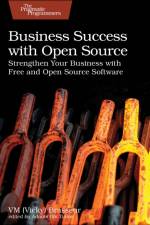
Free and open source software (FOSS) is everywhere and is the driving force behind nearly all software developed today. It doesn't matter what industry your company is in: Learning more about how to use, contribute to, and release FOSS can be the strategic edge that your company needs. With the proper knowledge and approach, open source can form the cornerstone of a digital transformation effort, increase developer retention, decrease recruiting cycles, ensure reliable security, and reinforce the company brand. All this and more, by shifting your company's FOSS strategy from accidental to intentional. Free and open source software (FOSS) is the whetstone of the cutting edge. Your company is almost certainly using FOSS right now, whether you know it or not. FOSS is already part of your company, so you need to know how to manage it effectively and strategically. If you're participating in a digital transformation effort, or reducing business risk, or building a product roadmap, or creating a company or team strategy, or if you need to round out your existing open source knowledge by filling in some gaps, this is the information you need. Discover how to use, contribute to, and release open source projects effectively and strategically for your business. Avoid the dangers inherent in license compliance and other intellectual property matters. Incorporate community management to bolster the sustainability of projects that are critical to your company. Manage your software supply chain to track and maintain the projects your company relies on. Create policies and procedures both for inbound and outbound FOSS engagement. Develop tactics for community management to ensure corporate open source efforts remain on target for business goals. Build your free and open source software strategy and go from accidental to intentional. What You Need: No software requirements, just a desire to help your company succeed through proper open source engagement.
Abonner på vårt nyhetsbrev og få rabatter og inspirasjon til din neste leseopplevelse.
Ved å abonnere godtar du vår personvernerklæring.