


Gjør som tusenvis av andre bokelskere
Abonner på vårt nyhetsbrev og få rabatter og inspirasjon til din neste leseopplevelse.
Ved å abonnere godtar du vår personvernerklæring.Du kan når som helst melde deg av våre nyhetsbrev.

International Economic Law (IEL) refers to the rules governing economic relations at the international level and involving States, international organizations and private entities. This textbook explores IEL within the broader context of public international law, providing all the foundational principles essential for the study of IEL.
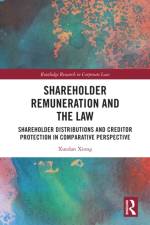
This book discusses the mechanism of shareholders' distribution restriction for creditor protection through an interdisciplinary lens. It will be of interest to researchers, students and practitioners in the field of company law, finance law, accounting and banking law.
The Routledge Handbook of Islamic Economics and Finance offers a detailed introduction to the current scholarship in this ever expanding and emerging field. It seeks to explore the current developments and trends in Islamic economics, Islamic banking and Islamic capital markets.
Principles of Bitcoin presents a holistic, first-principles-based framework for understanding one of the most misunderstood inventions of our time.
Looks at how digitalization has changed the way we produce and interact, and the implications for working classes and countries of the Global South.
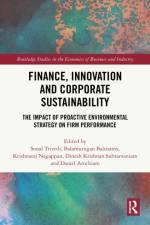
This book explores how the problem of global sustainability could turn into a major force for innovation leading to enhanced firm performance. The goal of the book is to advance the rapidly developing field of sustainable business beyond the straightforward logic of cost, waste and risk reduction.
The first comprehensive handbook on the economic analysis of terrorism. A fundamental reference for understanding terrorism in academia, government, and law enforcement. It combines chapters on general themes such as the economic approach to studying terrorism with focused chapters on key issues such as counterterrorism and terror organizations.
Digital Internationalisation of Firms offers a comprehensive examination of the digital outward internationalisation of firms, focusing on both Internet-based and Internet-enabled businesses, including SMEs and large enterprises.
?Absolutely essential reading for every LEGO fan.? ?BlocksThe definitive history of LEGO, based on unprecedented access to the company's archives and rare interviews with the founding family who still owns the company"This book tells the story of how my family built the LEGO brand." ?Kjeld Kirk Kristiansen, former President/CEO of the LEGO Group and 3rd generation ownerIt's estimated that each year between eighty and ninety million children around the globe are given a box of LEGO, while up to ten million adults buy sets for themselves. Yet LEGO is much more than a dizzying number of plastic bricks that can be put together and combined in countless ways. LEGO is also a vision of the significance of what play can mean for humanity.This book tells the extraordinary story of a global company and a Danish family who for ninety years have defended children's right to play?and who believe grown-ups, too, should make the time to nurture their inner child. The LEGO Story is built on Jens Andersen's unique access to LEGO's own archives, as well as on Andersen's extensive conversations with Kjeld Kirk Kristiansen, former president and CEO of the LEGO group and grandson of its founder, Ole Kirk Christiansen.A riveting cultural history of changing generations' views of childhood and the importance of play, The LEGO Story also a fascinating case study of how innovation and creativity helped leaders transform LEGO from a small carpentry business into the world's largest producer of play materials and one of the most beloved brands in the world. Richly illustrated with never-before-seen photos from the family's private archive, this is the ultimate book for fans of LEGO, revealing everything you ever wanted to know about the brand. An International Bestseller
A fresh and distinctive perspective on the contemporary fairground in striking images.
This book explores the historical and theoretical classification of True Cost Accounting (TCA) and its business-oriented ways of implementation. It will interest students and scholars of environmental economics and inspire practitioners in sustainable supply chain management and social accounting.
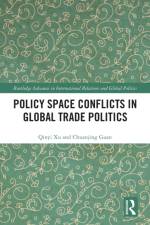
Policy Space Conflicts in Global Trade Politics delves into the structure, driving forces, and contemporary influencing factors of trade relations dynamics, providing insights into the present and future trajectories of the global trade order.
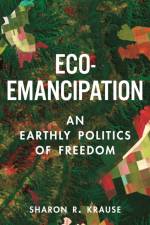
The case for an eco-emancipatory politics to release the Earth from human domination and free us all from lives that are both exploitative and exploitedHuman domination of nature shapes every aspect of our lives today, even as it remains virtually invisible to us. Because human beings are a part of nature, the human domination of nature circles back to confine and exploit people as well-and not only the poor and marginalized but also the privileged and affluent, even in the world's most prosperous societies. Although modern democracy establishes constraints intended to protect people from domination as the arbitrary exercise of power, it offers few such protections for nonhuman parts of nature. The result is that, wherever we fall in human hierarchies, we inevitably find ourselves both complicit in and entrapped by a system that makes sustainable living all but impossible. It confines and exploits not only nature but people too, albeit in different ways. In Eco-Emancipation, Sharon Krause argues that we can find our way to a better, freer life by constraining the use of human power in relation to nature and promoting nature's well-being alongside our own, thereby releasing the Earth from human domination and freeing us from a way of life that is both exploitative and exploited, complicit and entrapped. Eco-emancipation calls for new, more-than-human political communities that incorporate nonhuman parts of nature through institutions of representation and regimes of rights, combining these new institutional arrangements with political activism, a public ethos of respect for nature, and a culture of eco-responsibility.
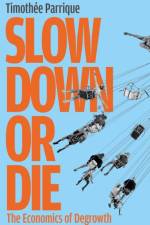
One of the most deeply ingrained beliefs of our age is that perpetual economic growth is the solution to most, if not all, of society's problems. In Slow Down or Die, French economist Timothée Parrique brilliantly challenges this myth, demonstrating how producing more won't solve climate change, poverty, or inequality. In fact, our obsession with growth is accelerating social and ecological collapse.Parrique proposes a different vision - a "post-growth" economy where decisions are made collectively and democratically. Instead of infinitely accumulating wealth, our goal must be a just, equitable, and sustainable society. Accessible and inspiring, Slow Down or Die is a radical call to embrace a future of shared prosperity, where slowing down is the key to a better, sustainable future.
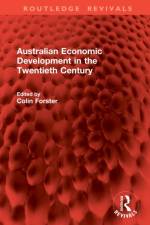
First published in 1970, Australian Economic Development in the Twentieth Century analyses aspects of Australian economic development in the twentieth century and places them in historical and international perspective.
The application of tools and techniques in construction projects greatly influence the cost-effectiveness results of construction projects and successful project performance. Quality management tools and techniques help in project planning, execution, monitoring, control and evolve a project management system that makes project deliverables.
This book delivers crucial historical background in these times, as bloc-building returns to the global economy and China and Russia massively intensify their economic cooperation.
This book explores the Supermultiplier model which has rapidly evolved into a key analytical framework, embraced and debated by Post-Keynesian economists across various schools of thought. The model extends Keynesian principles to the long run, asserting that economic growth and productive capacity arE shaped by effective demand.
Why Democracy Needs the Rich challenges the prevailing narrative that wealth undermines democracy, offering a bold, thought-provoking case for the essential role of the rich in sustaining and enhancing democratic institutions. In a time when billionaires are often vilified as symbols of inequality and unchecked power, John O. McGinnis flips the script, arguing that the wealthy are not just vital contributors to innovation and economic growth but also indispensable counterbalances to the influence of other powerful groups. Drawing on history, economics, and political philosophy, McGinnis illustrates how the rich act as stabilizers in a democracy by funding civic institutions, championing diverse ideas, and driving technological progress. He reveals how wealth can counteract the sway of ideologically homogeneous elites in media, academia, and entertainment while serving as a check on the excesses of special interest groups and bureaucracies. With sharp analysis and compelling examples, this book explores the unique role of the wealthy in preserving the balance and dynamism of a free society. It highlights how their financial independence fosters ideological diversity and their investments fuel advancements that benefit all citizens, not just the elite. Far from being a defense of inequality, Why Democracy Needs the Rich is a powerful argument for understanding how wealth, in the right context, strengthens the foundations of representative democracy and fosters a more resilient, vibrant society.
Abonner på vårt nyhetsbrev og få rabatter og inspirasjon til din neste leseopplevelse.
Ved å abonnere godtar du vår personvernerklæring.