






















Gjør som tusenvis av andre bokelskere
Abonner på vårt nyhetsbrev og få rabatter og inspirasjon til din neste leseopplevelse.
Ved å abonnere godtar du vår personvernerklæring.Du kan når som helst melde deg av våre nyhetsbrev.

A flexible supply chain system creates postal communication agility and adaptability to respond to the changing technologies of the modern era. This book focuses on how Industrial Engineering can be used to achieve flexibility, resiliency, and efficiency in response to the needs of the global postal system.
This book underscores the post-COVID global uncertainties that are still occurring on the world stage and presents the recent challenges such as geo-political tensions, war, economic disturbances, climate change, the energy crisis in Europe, recessions in developed economies and their effect on developing and least developed economies.
The Routledge Companion to Disability and Work explores the realities faced by disabled individuals in the workplace and beyond. This comprehensive guide is essential for students, teachers, and researchers looking to intersect disability and business, paving the way for a more inclusive and equitable future.
This book explores the challenges of implementing ERM from technical, cognitive and social perspectives to enhance the organisations capacity to generate and integrate information and knowledge about risk and uncertainty.
Fanatic explores the concept of fanaticism, the psychological drivers of fanatics, and the commonalities across their experiences. Capturing the stories of those who consider fanaticism as core to their self-concept and interviewing experts in clinical and sport psychology, Joe Ungemah identifies core motivations across the social, physical, cognitive, and emotive domains. Exploring these, Ungemah demystifies the concept of fanaticism and recognizes its benefits. He argues that we all have the potential to become fanatics, and that fanaticism should be embraced for the sense of purpose and identity that it can foster and the opportunity for connection it can provide.
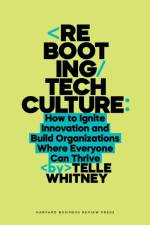
Build a more innovative, inclusive culture that welcomes all talent.Many technology leaders believe in having more women and people of color in technical and leadership positions in their organizations while still exhibiting reverence for the lone genius, almost always male, that they believe is imperative to their innovative future. They hold these two ideals as separate.Why? According to Telle Whitney, cofounder of the Grace Hopper Celebration of Women in Computing, tech leaders want to talk about inclusivity, but few fundamentally change their culture to dismantle the unwelcoming environment, fearful that doing so will compromise innovation. Women and people of color pay the price, facing exclusive and even hostile workplaces. They're held back from professional growth and in many cases, choose to leave the industry altogether.But there is a solution. In Rebooting Tech Culture, Whitney explains that the same values at the heart of a culture of innovation--creativity, courage, confidence, curiosity, communication, and community--can also foster a culture that is welcoming to all employees. Drawing on more than 50 interviews with tech executives and a survey of 1,000 people in tech, she shows how these "six Cs" can power real change in technology organizations, creating workplaces where anyone can be successful and where innovation thrives.Today, every company is a tech company. By understanding how to apply these values and reinvigorate their cultures, leaders will learn how to eliminate the behaviors holding their teams back from true belonging, creative growth, and true innovation.
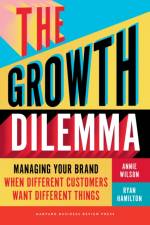
Porsches for soccer moms? Finance bros in Patagonia? Bud Light Pride cans? Drive-through Starbucks? What happens when your growth strategy creates conflict between customers?You always want to grow your brand, but there's a dilemma: the more customer segments you target for growth, the harder it becomes to avoid conflict. Sometimes you do such a good job building a loyal following that attempts to court other customers feel like betrayal to your core. Sometimes, a segment adopts your products without you targeting them, alienating your existing customers. Sometimes, your growth strategy flies in the face of what people have decided your brand means to them.Welcome to "the conflict zone," where brands must navigate these incompatibilities to achieve growth--or face losing customers rather than growing. How did Supreme's attempts to cross over cost the brand its coveted reputation among skateboarders? How did Apple lose one of its most devoted customer bases when it updated a piece of software? What does Gucci do when the cast of Jersey Shore starts toting their handbags around?Marketing experts and professors Annie Wilson and Ryan Hamilton answer these questions, and through dozens of cases provide insight into how brands can drive growth by attracting new segments without alienating or losing their current customers. With a fresh, simple framework for growing without imploding, Wilson and Hamilton show you how to recognize when you're heading for the conflict zone, how to steer clear of it, and what to do if you find yourself in it.Here you'll find a better way to strategically select new target markets and evaluate, monitor, and manage multiple customer segments. The Growth Dilemma is your road map to brand growth.
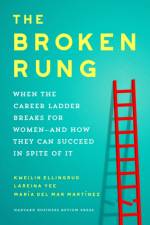
The broken rung: a phenomenon even more pervasive than the glass ceiling in holding women back from career success. This book explains it and gives you strategies for how to overcome it and fulfill your potential.Women around the world do extremely well when it comes to their education. They graduate at higher rates than men do and have higher average GPAs. But then a strange thing happens: Upon entering the workforce, they immediately lose their advantage. When the first promotions come around, the slide continues--for every 100 men who are promoted to manager, only 87 women and 73 women of color get promoted.This is what McKinsey senior partners Kweilin Ellingrud, Lareina Yee, and María del Mar Martínez call "the broken rung," and its effects compound throughout women's careers, causing women to fall behind at the start and keeping them from catching up. In this groundbreaking book, the authors reveal the problem's underlying cause: while about half of a person's lifetime earnings come from education and half from experience, men get more value from their experience than women do. As the authors show, it is also here, in one's experience, that the solution lies: How can women build their "experience capital" to level the playing field and maximize their earning potential?Based on over a decade of research, conversations with more than 50 remarkable leaders, and their own experiences as senior partners and as the first three consecutive chief diversity and inclusion officers for McKinsey, the authors weave data on the potential pitfalls across a career with inspiring and instructive stories of women who have climbed over the broken rung by using strategies that increased their experience capital.Leaders and companies must do more to address structural gender inequalities in the workplace--but you don't have to wait. The Broken Rung is your guide, right now, for moving up the corporate ladder and reaching your full potential at work.
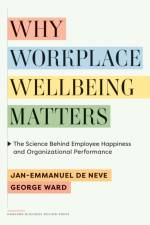
The most comprehensive, in-depth picture yet of workplace wellbeing and its key drivers, providing new perspective on the intersection of happiness, productivity, and organizational success.Most of us spend a third of our waking lives at work. Work sets our schedules, influences our relationships, shapes our identities, and drives our economies. But is it actually making us happy?This is a deep and profoundly important question, and now leading Oxford researchers Jan-Emmanuel De Neve and George Ward provide the richest, most comprehensive picture yet of workplace wellbeing. In Why Workplace Wellbeing Matters, the authors provide clarity on what workplace wellbeing is (and is not), and how to think about and approach it as a business.Mining a variety of the largest and most in-depth data sources--including a unique, massive dataset gathered in partnership with the jobs platform Indeed--the book illustrates the remarkable ways in which wellbeing at work varies across workers, companies, industries, and geographies. It also provides new, data-driven insights into the origins of workplace happiness and how to effectively move the needle on improving our working lives.Drawing on work in economics, psychology, sociology, management, and other disciplines, the authors explain that workplace wellbeing includes both how we think about our work as a whole and how we feel while we're at work. They show, using innovative new data and empirical methods, that improving wellbeing can help raise productivity as well as aid in the retention and recruitment of talent--ultimately leading to companies' better financial performance.With keen insight and nuanced analysis, Why Workplace Wellbeing Matters dispels myths and tests assumptions that have arisen amidst an often-confusing cacophony of voices on wellbeing at work. It also provides a firm foundation and indispensable resource for leaders as they shape the future of work.
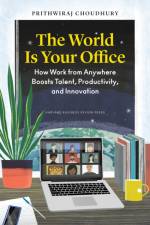
A research-based look at a growing phenomenon--companies allowing their employees to work from anywhere in the world--and how those who adopt this model can boost talent, innovation, and productivity.In recent years, companies in a wide range of industries have adopted radically flexible work policies that allow employees and teams to work from anywhere (WFA), untethered to a physical office. The leaders at these companies understand that geographic flexibility is a competitive advantage: a way to attract and retain high-quality and diverse talent at a global scale. If other companies want to find and keep the very best talent, they must embrace WFA.In The World Is Your Office, Harvard Business School professor Prithwiraj Choudhury takes readers inside the companies at the forefront of this growing phenomenon--from startups to bigger, more traditional organizations--while offering leaders a playbook for implementing a variety of WFA policies they can tailor to their own needs. This includes: Using WFA as a means of hiring and retaining the best talent in your fieldBest practices for meeting the challenges of managing a WFA team or workforce, including ways to build community, improve communication, and share knowledgeUnderstanding how AI and automation are extending WFA to manufacturing and other deskless settingsCase studies of companies that have implemented WFA to great effectFilled with smart insights and in-depth examples, and inspired by a decade's worth of pioneering research, The World is Your Office will help leaders attract superior talent, boost innovation, and improve productivity and diversity.
At the intersection of reverse innovation and design thinking, you can find opportunities to create innovations that are Global by Design.We are living in an era when innovators must turn their sights to the global stage as never before, to both solve wicked problems facing the world and capture the economic opportunities presented by emerging markets. Thoughtful, innovative solutions can be truly global in scope, providing the value necessary for large-scale adoption in developing countries and disrupting equivalent products in wealthy markets by offering high performance at low cost.But it will require a diligent, targeted design process to make these innovation growth opportunities a reality, and Winter and Govindarajan deliver the practical approach you need in Global by Design.A book born from the mutual appreciation, and interdependence, of their backgrounds--Winter is a rock star in engineering design and Govindarajan a longtime leading expert on strategy and innovation--Global by Design provides what you need to get started, whether you work in a C-suite, an engineering cubicle, the workshop floor, a classroom, the halls of government, or an NGO field office.No matter your discipline, level of training, or location in the world, you have valuable knowledge and perspective that can be leveraged to spot consequential problems, leverage innovation to solve them, and create an ecosystem for driving the creation of high-value, low-cost solutions that have global appeal--that are Global by Design.
Learn how businesses can leverage their success to drive positive social impact. Kurt Avery delves into a range of proven business and marketing techniques, including some developed through his own professional experiences as the founder, owner, and president of Sawyer Products.Sawyer Products has achieved remarkable success with its innovative water filtration and insect repellent products, but it hasn’t stopped there. Sawyer Thinks reveals how the company has harnessed its profitability to make a significant charitable impact worldwide and provides a clear roadmap that other businesses can follow.Sawyer Thinks aims to inspire and empower business leaders to think beyond the bottom line and use their resources to create meaningful change. It includes a step-by-step guide on increasing charitable giving and philanthropic efforts while also enhancing overall profitability and sustainability.
The premise of this book is that research into gossip, organization, and work is an important idea whose time has come. A key feature of the book is the inclusion of 'practice points' showing how - and where - theory and/or research intersect with practice, and vice versa.
If you're ready to live according to your values, to create a plan that you can follow, and to form a tribe of people who support you in life and work, keep reading. In her first book, Fabiana Lacerca-Allen takes you along on her journey of critical moments that she has experienced, including kidnapping attempts and high-stake international negotiations.
Businesses have faced many difficulties as a result of the global pandemic. Digital technologies have played a crucial role in addressing these issues and fostering resilience. It is, therefore, imperative to explore options for post-pandemic business transformation and rethinking sustainable development.
This comprehensive volume offers ideas, examples, and guidance to help coaches develop skills in their coaching practice, specifically in the areas of health and wellbeing as they are experienced by their clients.
This comprehensive volume offers ideas, examples, and guidance to help coaches develop skills in their coaching practice, specifically in the areas of health and wellbeing as they are experienced by their clients.
This volume serves as an essential theoretical guide to debates around corporate purpose, CSR and ESG today.
Jim Ewing started his professional life as a rocket scientist, but it soon became evident that his real passion was for people. He saw that life is about navigating change - braving uncertainty, living well at our ' learning edge' . He set out to develop a way to support others, " a conversational, casual, no-frills and no-waiting intervention to be a first responder for individuals and for groups when steep change and life redesign come calling" . Over time he grew a successful consulting business, working with companies and organisations innovating through change or tackling ' wicked' problems. He designed a family of maps to support this work - simple frameworks for transformative conversations for use with individuals, groups, communities, organisations. Here Jim introduces the maps and the thinking that lies behind each of them, plus the conversational craft that brings them all to life. For those interested in pursuing the practice further, he points in the final chapter to Executive Arts, the small circle of colleagues and fellow practitioners to whom he entrusted the further development and spread of his work.
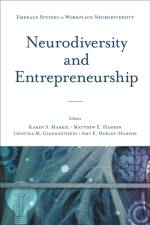
Neurodiversity and Entrepreneurship increases our understanding of how different types of entrepreneurial activity may help to improve the inclusion of neurodiverse individuals in the workplace and society.
This book will help facilitate successful leadership transition in museums and arts organizations.
Abonner på vårt nyhetsbrev og få rabatter og inspirasjon til din neste leseopplevelse.
Ved å abonnere godtar du vår personvernerklæring.