









Gjør som tusenvis av andre bokelskere
Abonner på vårt nyhetsbrev og få rabatter og inspirasjon til din neste leseopplevelse.
Ved å abonnere godtar du vår personvernerklæring.Du kan når som helst melde deg av våre nyhetsbrev.

In order to fight capitalism in the digital age, we must understand Marx!
How Kids Can Live, Learn, and Love in a Digital World.
Category theory reveals commonalities between structures of all sorts. This self-contained tour of applied category theory shows its potential in science, engineering, and beyond. Each chapter discusses a real-world application using category-theoretic tools, all of which are introduced in an accessible way with many examples and exercises.
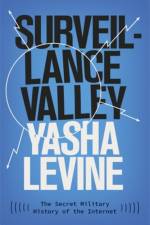
An explosive, revisionist history of the dark past, and darker present of the internet.
A best-selling author and renowned security expert reveals the rise and risks of a new goliath: our massively networked, world-sized web.
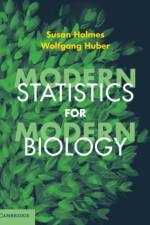
A far-reaching course in practical advanced statistics for biologists using R/Bioconductor, data exploration, and simulation.
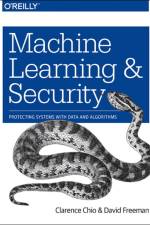
Can machine learning techniques solve our computer security problems and finally put an end to the cat-and-mouse game between attackers and defenders? Or is this hope merely hype? Now you can dive into the science and answer this question for yourself! With this practical guide, youll explore ways to apply machine learning to security issues such as intrusion detection, malware classification, and network analysis.Machine learning and security specialists Clarence Chio and David Freeman provide a framework for discussing the marriage of these two fields, as well as a toolkit of machine-learning algorithms that you can apply to an array of security problems. This book is ideal for security engineers and data scientists alike.Learn how machine learning has contributed to the success of modern spam filtersQuickly detect anomalies, including breaches, fraud, and impending system failureConduct malware analysis by extracting useful information from computer binariesUncover attackers within the network by finding patterns inside datasetsExamine how attackers exploit consumer-facing websites and app functionalityTranslate your machine learning algorithms from the lab to productionUnderstand the threat attackers pose to machine learning solutions
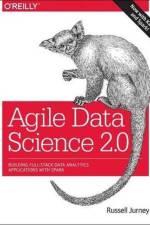
Data science teams looking to turn research into useful analytics applications require not only the right tools, but also the right approach if theyre to succeed. With the revised second edition of this hands-on guide, up-and-coming data scientists will learn how to use the Agile Data Science development methodology to build data applications with Python, Apache Spark, Kafka, and other tools.Author Russell Jurney demonstrates how to compose a data platform for building, deploying, and refining analytics applications with Apache Kafka, MongoDB, ElasticSearch, d3.js, scikit-learn, and Apache Airflow. Youll learn an iterative approach that lets you quickly change the kind of analysis youre doing, depending on what the data is telling you. Publish data science work as a web application, and affect meaningful change in your organization.Build value from your data in a series of agile sprints, using the data-value pyramidExtract features for statistical models from a single datasetVisualize data with charts, and expose different aspects through interactive reportsUse historical data to predict the future via classification and regressionTranslate predictions into actionsGet feedback from users after each sprint to keep your project on track
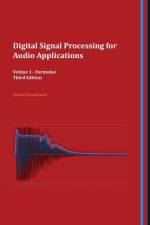
In the summer of 2003 we began designing multi-track recording and mixing software Orinj at RecordingBlogs.com a software application that will take digitally recorded audio tracks and will mix them into a complete song with all the needed audio production effects. Manipulating digital sound, as it turned out, was not easy. We had to find the answers of many questions, including what digital audio was, how we could mix audio tracks, how we could track the amplitude of digital sound so that we could apply compression, how we could track frequencies so that we could equalize, what a good model of artificial reverb would be, and many others. Bits of relevant information were available, albeit not always well organized and not always intuitive.Digital Signal Processing for Audio Applications provides much of the needed information. It is a simple structured approach to understanding how digitally recorded sound can be manipulated. It presents and explains, and sometimes derives, the mathematical theory that the DSP user can employ in designing sound manipulating applications.Although this book introduces much mathematics, we have designed it not for mathematicians, but for the engineers and hobbyists, who would be interested in the practical applications of DSP and not in its theoretical derivations. If properly explained, much of the practical DSP applications reduce to simple algebra. This said, we have included a sufficient amount of theory to provide an explanation of why DSP works the way it does. It is important for practitioners to have a good understanding of how DSP concepts come about. Much of the available DSP information has too much theory and not enough examples. Much of it has too many practical examples and not enough theoretical backing. We hope to have found the proper balance.This edition contains Java code samples for several digital signal processing effects delay, chorus, equalizer, reverb, compressor, wah wah, pitch shift, and more. These are a significant addition and are presented in a separate volume 2. Selected relevant sections of the previous edition of this book are also placed in volume 2.The first edition of this book focused on signal frequencies identifying them, filtering them out, changing their magnitude, and so on. This is a huge part of DSP for audio, but there is more. The second edition introduced significant additions: wavelet transforms and data compression, more windows, and elliptic filters. This third edition includes shelving and peak filters, improves the discussion of the Hilbert transform, and, of course, introduces a number of code samples as part of volume 2.
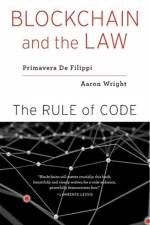
How does Bitcoin mine money from 1s and 0s? Through blockchain, a tool for creating secure, decentralized peer-to-peer applications. The technology has been compared to the Internet in impact. But disintermediation-blockchain's greatest benefit-cuts out oversight along with middlemen. Blockchain and the Law urges the law to catch up.
A heart-stopping ride with a dangerous compulsion beyond control, Tony 10 is the story of the postman who stole EURO1.75 million from the local post office, where he was a branch manager, to fund a gambling addiction that began with a bet of EURO1 and ended with the loss of more than EURO10 million, his family, his home - and won him a prison sentence.
This gorgeously illustrated guide to the tips, shortcuts, and workarounds will help you become an iPhone master. Written by Missing Manual series creator and former New York Times columnist David Pogue, this updated guide shows you everything you need to know about the new features and user interface of iOS 10 for the iPhone.
Abonner på vårt nyhetsbrev og få rabatter og inspirasjon til din neste leseopplevelse.
Ved å abonnere godtar du vår personvernerklæring.