












Gjør som tusenvis av andre bokelskere
Abonner på vårt nyhetsbrev og få rabatter og inspirasjon til din neste leseopplevelse.
Ved å abonnere godtar du vår personvernerklæring.Du kan når som helst melde deg av våre nyhetsbrev.

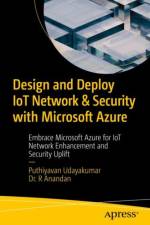
Unlock the potential of IoT with Microsoft Azure through this comprehensive guide, designed to elevate your understanding and implementation of cutting-edge IoT network and security solutions. Whether you are a beginner or a seasoned professional, this book offers clear, actionable insights to help you master the intricacies of IoT with Azure. This book equips you with the expertise to design and deploy secure, efficient, and scalable IoT networks using Microsoft Azure. It is your key to becoming a proficient IoT architect and security specialist. What You Will Learn Know the fundamentals of IoT networks and security, including key concepts, terminologies, and the importance of securing IoT deployments Dive into Azure Edge Services to design and deploy edge solutions that bring computation and data storage closer to the data source, enhancing speed and efficiency Explore the architecture and deployment of Azure IoT networks to gain practical knowledge on setting up scalable, reliable, and secure IoT networks tailored to your needs Study best practices and strategies for securing your IoT environment and ensuring robust protection against emerging threats Monitor and manage your IoT solutions effectively via tools and techniques for maintaining optimal performance, diagnosing issues, and ensuring seamless operation of your IoT networks Who This Book Is ForIoT network and security engineers, architects, and Azure IoT developers
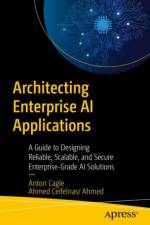
This book explores how to define, design, and maintain enterprise AI applications, exploring the impacts they will have on the teams who work with them.The book is structured into four parts. In Part 1: Defining Your AI Application, you are introduced to the dynamic interplay between human adaptability and AI specialization, the concept of meta systems, and the mechanics of prediction machines. In Part 2: Designing Your AI Application, the book delves into the anatomy of an AI application, unraveling the intricate relationships among data, machine learning, and reasoners. This section introduces the building blocks and enterprise architectural framework for designing multi-agent systems. Part 3: Maintaining Your AI Application takes a closer look at the ongoing life cycle of AI systems. You are guided through the crucial aspects of testing and test automation, providing a solid foundation for effective development practices. This section covers the critical tasks of security and information curation that ensure the long-term success of enterprise AI applications. The concluding section, Part 4: AI Enabled Teams, navigates the evolving landscape of collaborative efforts between humans and AI. It explores the impact of AI on remote work dynamics and introduces the new roles of the expert persona and the AI handler. This section concludes with a deep dive into the legal and ethical dimensions that AI-enabled teams must navigate.This book is a comprehensive guide that not only equips developers, architects, and product owners with the technical know-how of AI application development, but also delves into the broader implications for teams and society. What You Will Learn Understand the algorithms and processes that enable AI to make accurate predictions and enhance decision making Grasp the concept of metasystems and their role in the design phase of AI applications Know how data, machine learning, and reasoners drive the functionality and decision-making capabilities of AI applications Know the architectural components necessary for scalable and maintainable multi-agent AI applications Understand methodologies for testing AI applications, ensuring their robustness, accuracy, and reliability in real-world applications Understand the evolving dynamics of human-AI coordination facing teams in the new enterprise working environment
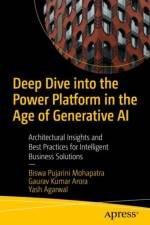
Understand the full potential of Microsoft Power Platform with this comprehensive guide, designed to provide you with the knowledge and tools needed to create intelligent business applications, automate workflows, and drive data-driven insights for business growth. Whether you're a novice or an experienced professional, this book offers a step-by-step approach to mastering the Power Platform. This book comes with an extensive array of essential concepts, architectural patterns and techniques. It will also guide you with practical insights to navigate the Power Platform effortlessly while integrating on Azure. Starting with exploring Power Apps for building enterprise applications, the book delves into Dataverse, Copilot Studio, AI Builder, managing platforms and Application life cycle management. You will then demonstrate testing strategy followed by a detailed examination of Dataverse and intelligent AI-powered Applications. Additionally, you will cover Power pages for external websites and AI-infused solutions. Each section is meticulously structured, offering step-by-step guidance, hands-on exercises, and real-world scenarios to reinforce learning.After reading the book, you will be able to optimize your utilization of the Power Platform for creating effective business solutions.What You Will Learn: Understand the core components and capabilities of Power Platform. Explore how Power Platform integrates with Azure services. Understand the key features and benefits of using Power Platform for business applications. Discover best practices for governance to ensure compliance and efficient management. Explore techniques for optimizing the performance of data integration and export processes on Azure
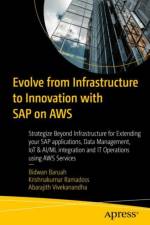
The world of SAP is undergoing a major transformation, with many customers either planning or actively modernizing their SAP landscapes as part of the S/4HANA digital transformation. Given the extensive SAP transformation efforts adopted by nearly all SAP customers in recent years and the profound impact these digital changes have had on their business models and IT organizations, the authors decided to write this book. As customers embark on their SAP on AWS journey, they face three main challenges: deciding on the overall strategy, selecting the right business use cases and implementing them effectively. This book aims to address these challenges by guiding readers through the process of identifying and executing the appropriate use cases. It will highlight how customers can harness AWS services beyond merely hosting their SAP systems on AWS, demonstrating the potential of these services to drive innovation. This book covers the entire journey, from defining strategy and identifying business use cases to their implementation, providing practical tips, strategies, and insights. It serves as an essential guide for customers planning to migrate or those who have already migrated their SAP workloads to AWS, helping them explore beyond just the infrastructure aspects of their journey. You Will : Discover how to go beyond just hosting SAP systems on AWS, using the full range of AWS services to innovate and extend your SAP applications. Learn how to identify the right business use cases and implement them effectively, with practical examples and real-world scenarios. Develop the mindset and skills needed to architect modern, cloud-native, event-driven architectures, balancing trade-offs between simplicity, efficiency, and cost.
Create video games from start to finish while learning game design and programming principles using GameMaker. Game Development with GameMaker covers all aspects of game design and development from the initial idea to the final release. You will learn how to make a 2D game from start to finish using GameMaker covering important features and topics related to game development. This book provides an in-depth guide to design and development of real-world video games, focusing on best practices aligned with industry standards. It covers all fundamental aspects of 2D game development, including movement, combat, AI, UI design, level design, inventory systems, power-ups, and more. This edition also features an additional chapter dedicated to artificial intelligence and incorporates the latest updates and best practices in GameMaker, including new features and enhancements. You Will Master GameMaker Language (GML) programming Apply game design principles and programming patterns Learn about 2D game development techniques and best practices Develop your own videogames exploring different game genres
This book simplifies the process of formalizing your cybersecurity program into something you can easily understand. Breaking down complex concepts into clear, manageable steps, the concepts are accessible even to those without a deep technical background. It ensures that more individuals within your organization can effectively contribute to building and maintaining a robust cybersecurity program. The book's structured framework focuses on the four key areas essential for any successful cybersecurity initiative, allowing you to prioritize efforts and transition from a reactive to a proactive stance."CyberDynamX" addresses the common challenge of developing efficient and comprehensive cybersecurity programs. Many tasked with this responsibility are not dedicated cybersecurity professionals, often juggling these duties alongside their primary roles. This can lead to fragmented efforts and incomplete solutions. The book provides clear, concise guidance that is easy to follow, ensuring meaningful progress even for those new to cybersecurity. By offering practical, actionable advice, "CyberDynamX" helps streamline the development process, enabling you to build an effective cybersecurity program that meets your organization's needs swiftly and efficiently.What You Will Learn: The four things to radically focus on in building a functional cybersecurity program. The importance of Risk Management and the means to get started performing this function. The significant difference between Policy, Standards, Procedures, Guidance and Baselines; when to use each and how to build them.
As artificial intelligence (AI) rapidly transforms education, tools like ChatGPT and Claude are revolutionizing the way we teach and learn. This book is a groundbreaking book that empowers parents and students to navigate this exciting new frontier, filling a critical gap in the current literature.As the first comprehensive guide to generative AI in education designed for parents and students, Generative AI in Education is positioned to become an indispensable resource. It provides the knowledge and strategies needed to effectively integrate AI into their learning journeys, transforming educational outcomes and preparing students for success in a rapidly changing world. Yoüll gain a deep understanding of how tools like ChatGPT and Claude work, and how they can be leveraged to support learning across various subjects and grade levels.Yoüll then see how to create clear, specific, and engaging prompts that elicit valuable responses from AI-powered tools. This book contains all the techniques for tailoring prompts to different learning objectives, styles, and contexts, and how they can use AI tools to support reading comprehension, writing skills, problem-solving, and creative thinking.What You Will Learn Apply generative AI in education Craft effective prompts for personalized learning experiences Utilize AI tools to support learning, creativity, and problem-solvingWho This Book is ForParents and students who are eager to harness the power of generative AI to enhance learning experiences and prepare for success in an AI-driven future
You were a happy coder, then the opportunity came to lead a team. Unfamiliar assignments come without warning, team members need care and attention, and then the organization demands that you take on roles you hadn't prepared for and work with people whom you have no idea what they do. It's a struggle to keep up and often feels like thrashing rather than success. And yet, you are the lynchpin. Software Managers are responsible for critical product delivery and information processing in the largest and most impactful global companies and across nearly every industry and public sector. Some of the fundamentals like project management and team leadership have been well documented but the world keeps getting more complicated. This book reveals the breadth of domains that a Software Manager will encounter as they progress from competent contributor to tech lead to manager to increasing levels of responsibility. Even experienced managers will find helpful new perspectives and insights. You will be challenged to think more deeply about the people you may manage, the processes of developing products so complex that no individual can keep it all in their head, and the often-mysterious organizational behaviors surrounding you.Tech companies don't have to throw good practitioners into hard management positions with no training and compound the error as people advance in their management careers; it has just been our habit. We can do better. Mastering the Complex World of Software Management provides realistic scope, attacks the nitty-gritty realities, and challenges the reader to think about their situation so they can solve the myriad technical, process, organizational, and business challenges coming their way.You will: Master the fundamentals of managing technology teams See how operating teams navigate themselves within a larger organization Understand and work around the landmines in software development
This comprehensive guide, featuring hand-picked examples of daily use cases, will walk you through the end-to-end predictive model-building cycle using the latest techniques and industry tricks. In Chapters 1, 2, and 3, we will begin by setting up the environment and covering the basics of PySpark, focusing on data manipulation. Chapter 4 delves into the art of variable selection, demonstrating various techniques available in PySpark. In Chapters 5, 6, and 7, we explore machine learning algorithms, their implementations, and fine-tuning techniques. Chapters 8 and 9 will guide you through machine learning pipelines and various methods to operationalize and serve models using Docker/API. Chapter 10 will demonstrate how to unlock the power of predictive models to create a meaningful impact on your business. Chapter 11 introduces some of the most widely used and powerful modeling frameworks to unlock real value from data.In this new edition, you will learn predictive modeling frameworks that can quantify customer lifetime values and estimate the return on your predictive modeling investments. This edition also includes methods to measure engagement and identify actionable populations for effective churn treatments. Additionally, a dedicated chapter on experimentation design has been added, covering steps to efficiently design, conduct, test, and measure the results of your models. All code examples have been updated to reflect the latest stable version of Spark.You will: Gain an overview of end-to-end predictive model building Understand multiple variable selection techniques and their implementations Learn how to operationalize models Perform data science experiments and learn useful tips
This book explains how to build digital twin metaverse cities aimed to accelerate urban digital transformation through emerging technologies. Why do we need to live in a smart city? The book presents a novel architectural design of digital twin metaverse cities and the digital twinning process. Let's dive into emerging technologies as building blocks to construct smart cities.Rapid urbanization causes compelling city problems worldwide, such as housing, traffic, schooling, healthcare, employment, and pollution. Numerous smart-city scholars and practitioners have attempted to tackle these problems but lack an integrated approach and practical implementation tools to solve them. In this book, we will build digital metaverse cities using emerging technologies. This approach begins by identifying a problem statement, designing a novel digital twin metaverse architecture, reviewing emerging technologies as building blocks and showcasing interesting applications.Moreover, we will review state-of-the-art digital twin metaverse development tools and present readers with interesting engineering prototypes of my proposed digital twin smart cities. Finally, we will discover how to avoid some management pitfalls during the construction of innovative smart cities, including project management, change management, leadership skills, and modern management information systems, providing a bonus for our readers.You will: Explore complex issues arising from rapid urbanization. Discover how emerging technologies like 5G, IoT, and AI can solve urban problems. Master the digital twinning process powered by the Data Analytics Flywheel. Explore core and enabling technologies shaping Digital Twin Metaverse Cities. Gain hands-on experience with development tools and prototypes for smart city applications.
Develop and implement AI strategies aligned with business goals, including operating models and partnership strategies. This book is practical guide for chief experience officers and other corporate board members faced with the complex issues of AI governance, data privacy, AI regulations, AI copyright, AI strategy, and more.Executives are eager to hear from other executives, peers, and authority figures regarding AI matters, and how to approach them quickly, correctly and meaningfully. The cost of missing out or messing up in AI transformation is easy so it¿s imperative that C-suite and board members have the right mental framework to ask the right questions for their organizations.Throughout this book, yoüll see how to develop and execute AI strategies that align with your organizational goals and ethical standards. Yoüll navigate the complex landscape of AI regulation and governance, applying best practices to ensure compliance and protect stakeholder interests. Yoüll also, understand how to innovate and adapt AI technologies within your operations.AI and the Boardroom provides all the right tools to guide decision-making, foster partnerships, and enhance customer experiencesWhat You Will Learn Master AI governance, regulations, and ethical considerations, including privacy and intellectual property issues. Optimize AI investments, budgets, and ROI through effective KPIs, OKRs, and risk management. Navigate organizational changes brought by AI, including executive compensation, team structures, and change management. Leverage AI for board-level decision-making while advancing organizational AI maturity and staying ahead of emerging trends.Who This Book Is ForSuite executives and corporate board members; technology and innovation leaders; risk management and compliance professionals; corporate strategists and business unit leaders; AI program managers and data scientists
Learn the United Nations Sustainable Development Goals (UN SDGs) and see how machine learning can significantly contribute to their realization. This book imparts both theoretical knowledge and hands-on experience in comprehending and constructing machine learning-based applications for addressing multiple UN SDGs using JavaScript. The reading begins with a delineation of diverse UN SDG targets, providing an overview of previous successful applications of machine learning in solving realistic problems aligned with these targets. It thoroughly explains fundamental concepts of machine learning algorithms for prediction and classification, coupled with their implementation in JavaScript and HTML programming.Detailed case studies examine challenges related to renewable energy, agriculture, food production, health, environment, climate change, water quality, air quality, and telecommunications, corresponding to various UN SDGs. Each case study includes related works, datasets, machine learning algorithms, programming concepts, and comprehensive explanations of JavaScript and HTML codes used for web-based machine learning applications. The results obtained are meticulously analyzed and discussed, showcasing the pivotal role of machine learning in advancing the relevant SDGs. By the end of this book, you'll have a firm understanding of SDG fundamentals and the practical application of machine learning to address diverse challenges associated with these goals.You will: Understand the fundamental concepts of the UN SDGs, AI, and machine learning algorithms. Employ the correct machine learning algorithms to address challenges on the United Nations Sustainable Development Goals (UN SDGs)? Develop web-based machine learning applications for the UN SDGs using Javascript, and HTML. Analyze the impact of a machine learning-based solution on a specific UN SDG.
This book is designed to help you prepare for Exam MS-721, which is required for Microsoft 365 Certified: Collaboration Communications Systems Engineer Associate certification.The book starts with an introduction to Exam MS -721 and Microsoft Teams. It discusses how to plan and design collaboration communications systems followed by configuration and management of Teams meetings and events. You will learn about Teams Phone and acquire the skills required to configure Direct Routing with Teams Phone. You will go through the configuration of Teams Phone and learn its user settings and features. Teams Meeting Rooms and devices, from deployment to troubleshooting, are discussed along with their Intune policies. And you will learn the configuration of MTRs based on Windows and Surface Hub.What You Will Learn Understand Microsoft Teams Plan and design meetings and collaboration Configure and manage Teams Phone Optimize the network for Teams and Teams certified devices Troubleshoot Teams calls and meetings
Create apps for iOS and Android phones and tablets using Flutter, a Google framework that produces two outputs for a single app. Let's face it, creating iOS apps using Apple tools such as Swift and Xcode is extremely complicated. Creating Android apps with Kotlin and Android Studio is just as difficult. This book breaks down complex concepts and tasks into easily digestible segments with examples, full-color pictures, and hands-on labs with starters and solutions.As you work through the accompanying lab exercises, you'll learn the Dart programming language; the entire Flutter development toolchain; the differences between stateful and stateless widgets; and a working knowledge of the architecture of apps. Yoüll work with themes and styles, develop custom widgets, and even teach your app to respond to gestures like taps, swipes, and pinches. Yoüll also design, create, and control the layout of your app. Create tools to handle form data entry from users. And ultimately create killer multiscreen apps with navigation, menus, and tabs.Yoüll see that with Flutter, you can write an app one time that produces two outputs: one that can be submitted to the Apple App Store and another that can be uploaded to the Google Play Store. In short, one code creates the same app that runs on iPhones, iPads, Android phones and tablets, virtually all devices. And if you like, it can also create a version that runs on Macs, Windows, Linux, and in browsers!Flutter App Development explains difficult topics in plain, everyday terms that simplify the process of writing mobile apps.What You'll Learn Get the most out of great Flutter widgets Create custom widgets, both stateless and stateful Exercise expert control over your Flutter layouts Manage data in stateful widgets and with libraries like Riverpod Exchange data actively with RESTful API serversWho This Book Is ForDevelopers who have coded in JavaScript, Python, Java, C#, C++, or any similar language. Managers, product owners, and business analysts who need to understand Flutter's capabilities.
Develop elegant and rock-solid systems using PHP, aided by three key elements: object fundamentals, design principles, and best practices. Now in its 7th edition, this book has been fully updated for PHP 8.3 and split into two volumes to better accommodate its wealth of new content. Volume 1 covers objects and patterns, while Volume 2 focuses on tools and best practices.Yoüll begin this volume by reviewing PHP's object-oriented features including key topics such as class declarations, inheritance, and reflection. The second part of the book is devoted to design patterns. It explains the principles that make patterns powerful and covers many of the classic design patterns, as well as enterprise and database patterns.This volume provides a solid grounding in PHP's support for objects and builds on this foundation to apply the core principles of software design. New topics covered include read only classes, enumerations, typed class constants, as well as various additions to argument and return types. The knowledge gained from this book will help you master the object-oriented enhancements and the design patterns available for PHP 8, paving the way for developing best practices in Volume 2.What You Will Learn Work with object fundamentals. Write classes and methods, instantiate objects, and create powerful class hierarchies using inheritance. Master advanced object-oriented features, including static methods and properties. Manage error conditions with exceptions and create abstract classes and interfaces. Use design principles to deploy objects and classes effectively in your projects. Discover a set of powerful patterns that you can implement in your own projects.Who This Book Is ForAnyone with at least a basic knowledge of PHP who wants to use its object-oriented features in their projects.
This book explicitly brings together Cognitive Digital Twins for smart lifecycle management of built environment and infrastructure and focuses on the challenges and opportunities of data-driven cognitive systems by integrating the heterogeneous data from multiple resources.
This book emphasizes the idea of understanding the motivation of the advanced circuits' design to establish the AI interface and to mitigate the security attacks in a better way for big data. It is for students, researchers, and professionals, faculty members and software developers who wish to carry out further research.
The purpose of this edited book is to provide state¿of¿the¿art approaches and novel technologies for smart ships coving a range of topics in the areas so that it will be an excellent reference book for the researchers, students and professionals in these areas.
This book presents an overview of modeling and simulation of environmental systems via diverse research problems and pertinent case studies, covering air pollution modeling, sustainable water resources modeling, IoT based applications in environmental systems, and future algorithms and conceptual frameworks in environmental systems.
The Future of HRM in a World of Persistent Virtual Reality delves into how the integration of VR technologies is revolutionizing HRM practices, challenging traditional norms, and creating new paradigms for work, employee engagement, training, and recruitment.
This book demonstrates how to use Oracle Cloud Infrastructure (OCI) and Hugging Face technologies to develop advanced NLP solutions. Through a practical case study, it addresses common NLP challenges and offers strategies for creating efficient, cost-effective transformer-based models. By the end of this book, you will have the skills and knowledge to create cutting-edge NLP solutions on OCI, customized to meet the needs of various industries and projects.The book takes you through the complete NLP solution life cycle-covering data preparation, model fine-tuning, deployment, and monitoring-while highlighting key topics such as cost-effectiveness and responsible AI for NLP implementations. Drawing from real-world experience and offering practical insights, it bridges the gap between theory and practice, equipping you to design and deploy scalable, cost-efficient NLP solutions.What You Will Learn Master key NLP concepts and the OCI ecosystem Create high-quality datasets using Hugging Face and OCI Data Labeling Service Fine-tune domain-specific pre-trained models from Hugging Face using OCI Data Science Notebook Sessions Deploy and operationalize your models with OCI Data Science Model Deployments Automate the NLP life cycle with OCI Data Science Pipelines Implement cost-effective strategies throughout the entire NLP life cycle, from dataset preparation to model training and deployment
In today's world, understanding data analytics, data science, and artificial intelligence is not just an advantage but a necessity. This book is your thorough guide to learning these innovative fields, designed to make the learning practical and engaging. The book starts by introducing data analytics, data science, and artificial intelligence. It illustrates real-world applications, and, it addresses the ethical considerations tied to AI. It also explores ways to gain data for practice and real-world scenarios, including the concept of synthetic data. Next, it uncovers Extract, Transform, Load (ETL) processes and explains how to implement them using Python. Further, it covers artificial intelligence and the pivotal role played by machine learning models. It explains feature engineering, the distinction between algorithms and models, and how to harness their power to make predictions. Moving forward, it discusses how to assess machine learning models after their creation, with insights into various evaluation techniques. It emphasizes the crucial aspects of model deployment, including the pros and cons of on-device versus cloud-based solutions. It concludes with real-world examples and encourages embracing AI while dispelling fears, and fostering an appreciation for the transformative potential of these technologies. Whether you're a beginner or an experienced professional, this book offers valuable insights that will expand your horizons in the world of data and AI. What you will learn: What are Synthetic data and Telemetry data How to analyze data using programming languages like Python and Tableau. What is feature engineering What are the practical Implications of Artificial Intelligence
Delve into the ideal resource for theory and research on parental monitoring and adolescents' disclosure and concealment from parents. This handbook presents ground-breaking research exploring how adolescents respond to parents' attempts to control and manage their activities and feelings. The chapters highlight how adolescents' responses are as important for their mental health and behaviour as parents' attempts to regulate them. Examining responsive, intrusive, and invasive parenting behaviours, the volume addresses modern challenges like monitoring in the digital age and medical decision-making. It covers cutting-edge research on diverse cultures and groups including Latinx, Turkish, Chinese, LGBTQ+, and chronically ill youth. The internationally recognized contributors offer insights from different theoretical perspectives and describe novel methodological approaches, focusing on variations across different developmental stages, contexts, and cultures.
This textbook presents a fascinating review of cryptography and cryptanalysis, from the earliest known cryptographic systems of 2,500 years ago up to modern computer-based systems.The text relates the earliest use of the monoalphabetic cipher in the ancient world, the development of the ¿unbreakable¿ Vigenère cipher, and an account of how cryptology entered the arsenal of military intelligence during the American Revolutionary War. Moving on to the American Civil War, the book explains the solution of the Vigenère ciphers used by the Confederates and the use of telegraph codes, before investigating the development of cipher machines throughout World War I and II, including development of the first digital computer, Colossus. The exposition then explores cryptology in the computer age, from public-key cryptography and web security to criminal cyber-attacks and cyber-warfare. The role of cryptography in the Internet of Things is also discussed, along with the potential impact of quantum computing.Topics and features: Presents a history of cryptology from ancient Rome to the present day, with a focus on cryptology in the 20th and 21st centuries Provides engaging examples illustrating use of cryptographic algorithms in different historical periods Reviews algorithms and devices used to create secret messages, and the various methods for breaking such messages Describes notable contributions to cryptology by Herbert Yardley, William and Elizebeth Smith Friedman, Lester Hill, Agnes Meyer Driscoll, and Claude Shannon Examines unsolved mysteries in cryptology, such as the Voynich Manuscript, the Beale Ciphers, the Kryptos sculpture, and the Zodiac killer ciphersThis engaging work is ideal as both a primary text for courses on the history of cryptology, and as a supplementary text for advanced undergraduate courses on cryptology and computer security. No prior background in mathematics is assumed, beyond what would be encountered in an introductory course on discrete mathematics.
This is a book about numbers and how those numbers are represented in and operated on by computers.
This book offers a systematic presentation of persymmetric adaptive detection, including detector derivations and the definition of key concepts, followed by detailed discussion relating to theoretical underpinnings, design methodology, design considerations and techniques enabling its practical implementation.
This book gives a detailed description about integration of blockchain technology and digital twin solutions in modern farming. This book covers the core principles, practical applications, and some real-world case studies, with offering a practical roadmap for implementing smart agriculture practices.
Become a full-stack web developer using the Microsoft Blazor framework and the techniques shown in this book. This new edition will have you building all kinds of applications in C# and Microsoft .NET 8, from static web sites to fully interactive single page applications, and desktop and mobile applications, in no time. At it's core, this book teaches you to build user interfaces and present data to a user for display and modification, capturing the user's changes via data binding. The book shows you how to access a rich library of .NET functionality such as a component modeling for building composable user interfaces-including developing reusable components that can be used across many pages and websites. New for this edition, the book now covers server communication using SignalR and/or gRPC, the use of virtualization to load large quantities of data efficiently, deployment and ahead-of-time compilation into WASM, new unit testing features, security using OpenID Connect, and more features added in Blazor in .NET 8.At it's core, Blazor provides a fresh take on web development by eliminating the need to learn different languages and frameworks for client- and server-side development. It also allows C# and .NET to be used on all sides-both server-side and client-side-providing a robust feature set that is well suited toward scalable, enterprise-level applications. With Blazor you can use all your experience in .NET 8 along with thousands of existing libraries, right in the browser. This book gets you proficient using this important toolkit for web application development.What You Will Learn Build user interfaces and display data for users to edit Capture user edits and changes via data binding Transfer data back and forth between server and client Communicate with services using REST, SignalR, or gRPC Develop reusable components and assemble them into bigger components Use routing to build single-page applications (SPAs) Build stable and maintainable software using unit testing Internationalize your application to reach more users Secure your Blazor application with OpenID Connect Build static interactive pages web pages optimized for SEO Use the same components to build mobile and desktop applications
Abonner på vårt nyhetsbrev og få rabatter og inspirasjon til din neste leseopplevelse.
Ved å abonnere godtar du vår personvernerklæring.